
High Top Shoes for Babies with Foot Issues: Supportive, Lightweight, and Flexible
Last updated: September 28, 2026 · By Juan Valenzuela, Certified Children’s Shoe Fitter
Does your baby struggle with balance, or have a foot condition that needs extra support? If a doctor or physical therapist recommended high top shoes but didn’t say which ones, I’m here to help. High top shoes can make a big difference for babies and toddlers with low muscle tone, severe flat feet, or unsteady walking, but some give far better support than others. As a certified children’s shoe fitter with over 10 years of experience, I’ll walk you through the high top shoes I recommend, including options for wide and extra wide feet.
Is Your Baby or Toddler Having Trouble Balancing?
It’s normal for babies to take a few tumbles as they learn to walk. But if your baby falls often or seems unusually unsteady, it’s worth a closer look. In my experience, one of the most common reasons is an underlying foot issue, like severe flat feet or weak ankles, that makes balancing harder. If your baby falls frequently, talk to their pediatrician, who can check for an underlying cause.

Another common cause is ill-fitting shoes. Shoes that are too short, too long, or the wrong shape can throw off your baby’s balance and cause blisters, calluses, and corns. Checking your baby’s shoes is a simple first step that can make a big difference.
How High Top Shoes Improve Balance
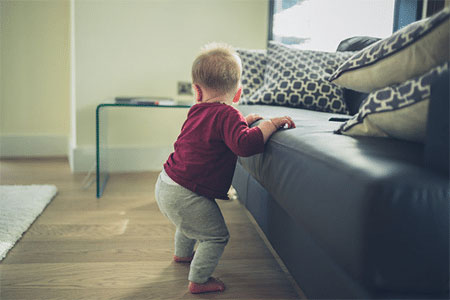
High top shoes are often recommended for babies with foot conditions because they add support around the ankle, which helps keep the foot stable. Most babies don’t need bulky orthopedic shoes; many everyday high top sneakers give enough support to help them walk and run with better alignment. For babies who need more, I’ve included one orthopedic option below.
Which Foot Issues Can High Top Shoes Help With?
In my experience, high top shoes are especially helpful for babies and toddlers with:
- Low muscle tone (hypotonia)
- Severe flat feet
- Weak ankles
- Toe walking tendencies
- Poor foot posture and balance
What to Look for in High Top Shoes for Babies
Ankle Support and a Firm Heel Counter
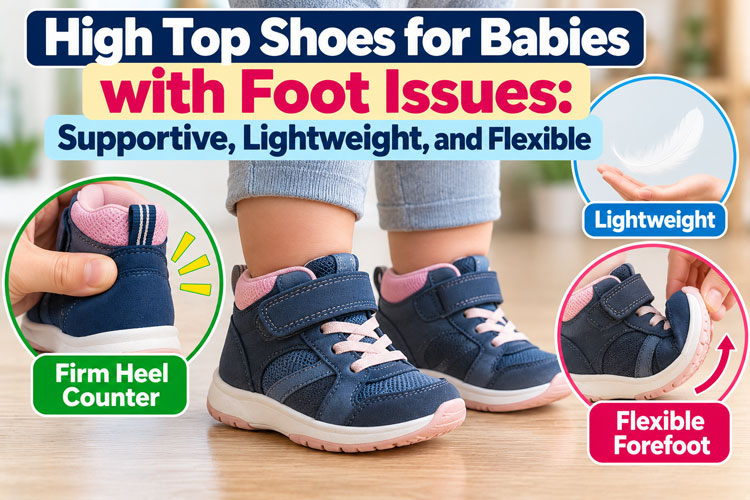
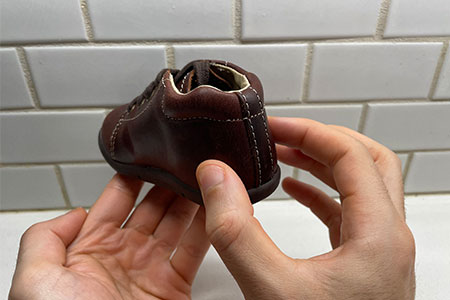
The heel counter is the back of the shoe that wraps around the heel. In a supportive high top, a firm heel counter holds the ankle in place and keeps the foot from rolling too far inward or outward, which helps prevent falls.
A Stable Base
Look for a broad, flat sole that spreads your baby’s weight evenly. A wide, stable base improves balance and leaves room for the toes to spread naturally.
Lightweight and Flexible
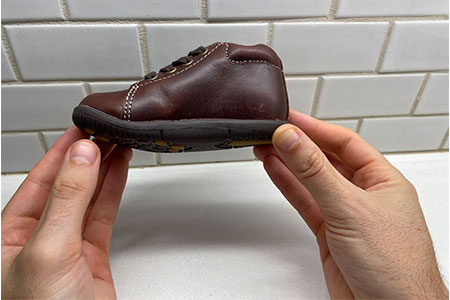
Support doesn’t have to mean heavy. The best high tops for babies are light and bend easily at the toes, so they move with your baby’s feet instead of restricting them.
Before You Buy: Not All High Tops Are Supportive
Choosing any high top shoe isn’t enough. Many high tops don’t give good support, and some are even less supportive than regular sneakers. Through years of fitting children’s shoes, I’ve learned which ones truly help. These are the ones I recommend.
Best High Top Shoes for Babies with Foot Issues
These high top shoes help guide the feet into better alignment, which can improve balance, walking confidence, and minor gait issues. Check each shoe’s Key Features to see which widths it comes in.
Disclosure: some links in this post are affiliate links — I may earn a small commission at no extra cost to you.
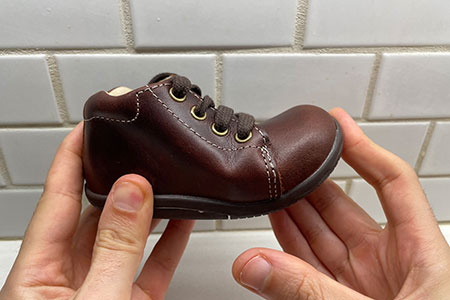
Elliott by Stride Rite
One of my go-to recommendations. It supports common foot issues, fits a range of foot shapes, and is budget-friendly.

Key Features
- Order on Amazon
- Fits medium, wide, and extra wide feet
- Ideal for babies with moderate cases of flat feet, low muscle tone, or balance concerns
- 100% leather construction
- High-top design provides extra ankle support
- APMA Seal of Acceptance
- Sizing tip: Order a whole size larger than your child’s current foot size
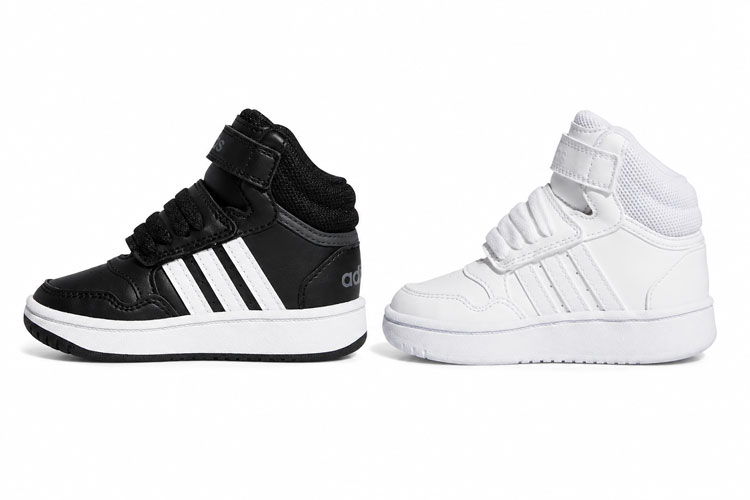
Hoops Mid 3.0 AC by Adidas
A high top with a cushioned midsole and good ankle support, plus a Velcro closure that makes it easy to get on and off.
Key Features
- Order on Amazon
- Fits medium and wide feet
- Ideal for babies with mild cases of flat feet, low muscle tone, or balance concerns
- Velcro closure for easy on and off
- Rubber cupsole for good grip
- Sizing tip: Order a whole size larger than your child’s current foot size
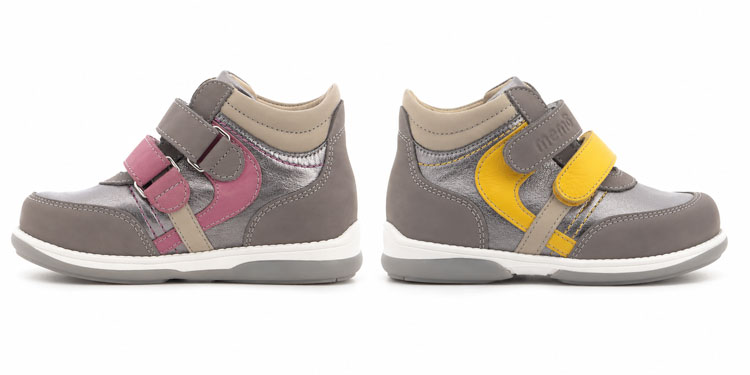
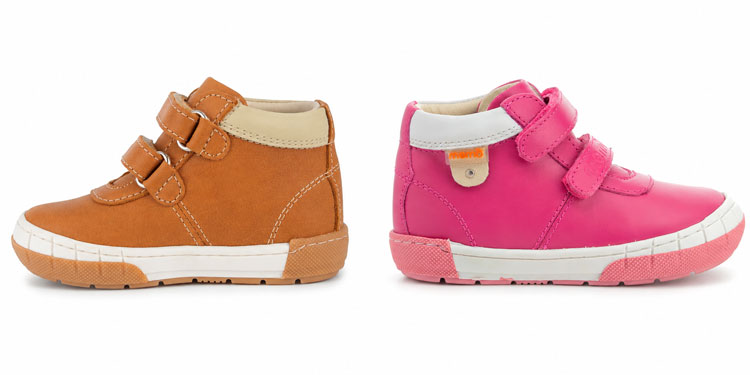
Gabi and Alvin by Memo (Orthopedic Shoe)
An orthopedic high top for babies who need more support than a regular sneaker gives, with a high, supportive heel and a firm outsole that stabilize the foot.
Key Features
- Order the model Gabi or Alvin on Amazon
- Also available in a Mary Jane style
- Fits medium and wide feet
- Ideal for strong cases of flat feet, low muscle tone, or balance concerns
- High-top design with stiff heel counters
- Sizing tip: Order a half size larger than your child’s current foot size. Refer to the Memo sizing chart
Order the Right Size Online
Getting the right size is especially important for babies. Shoes that don’t fit can make foot issues worse, and babies’ feet grow quickly, so a shoe that fits today may be too small in a few months. My guide to measuring your kid’s feet helps you find your baby’s size and width at home, with the right amount of growing room.
Watch My Video: Supportive vs. Unsupportive High Tops
In this video, I show the features that make high top shoes truly supportive, with a side-by-side comparison of supportive and unsupportive high tops so you know what to look for.
Need a Specific Recommendation?
Every baby’s feet are different. Email me with your baby’s foot condition and foot shape, and I’ll suggest the shoes most likely to help. You can also leave a question in the comments below.
FAQ
Most don’t. High tops are most helpful for babies with low muscle tone, severe flat feet, weak ankles, or balance problems. If your baby walks steadily, lightweight, flexible shoes are usually enough.
While babies are learning to walk, barefoot is best whenever it’s safe, since it helps build strength and balance. Save shoes for outings, like the mall or the playground, and choose ones that are very lightweight and flexible.
Yes, if they’re supportive. Look for a firm heel counter, a stable base, and flexibility at the toes, like the Stride Rite Elliott.
Some falling is normal while babies learn to walk. If your baby falls much more than other children their age, seems unusually unsteady, or walks on their toes, talk to their pediatrician.

Hell Juan Pablo,
First, let me thank you for making a site dedicated to shoes for children.I ordered two pairs of the white high top shoe for both my daughters and their stability has improved significantly. Thank you again for the much needed and valuable information! I will be coming back next time they are ready for new shoes.
I am glad that they worked out! Please let me know if you have any other questions!
Hello Juan Pablo. Congratulations on a good website. I enjoyed it and the page that I am commenting on is filled with good things. I mean, there can not be a stone that you have not turned over.
So many ideas are covered here like the fact that toddlers taking there first steps should walk in bare feet for a while to build up strength. Also, you point out that parents are always pushing our kids to walk early and I think part of this is that we parents are kind of embarrassed when the child doesn’t just “take off”. But you point out that it is in the child’s own DNA (my thought) to walk when they want too and not to push them. Good point.
I like the personal stories you shared with Jonas and his family in the mall. That is a cool story and good for you as you must be a friendly person. Also the point of wearing the proper socks and the point about “instep” and the point that kids feet are more apt to get wider faster than longer….who would of thought it.
Duane.
I am glad you enjoyed reading my website and this post in particular. I believe that shoes play a key role in keeping our kids feet and legs healthy, and something so simple such as providing our kids with the correct shoe size and the correct shoe style, will prevent them from getting injuried and developing several foot problems.
And yes, when babies are learning how to walk, barefoot is always best!
Thanks for stopping by!
Hi Pablo,
Great article, I’ve found it super interesting!
When my children were babies, I’ve let them walk barefoot most of the time as I thought it was the best for their feet. They were wearing shoes only occasionally when we were going in town or somewhere where shoes were a must to be worn.
Today, my daughter has problems with her feet, and the sad thing is that the orthopedic says that there is nothing to any more about it. However, it is imperative to choose the right shoes for our precious little babies:).
My sister gave birth a few months ago, and I will share this great article with her, I am sure she will love it!
Thank you for this excellent post!
Hello Danielle,
When a child is learning how to walk it’s always best to allow them to walk barefoot, and we only put shoes on them when we take them to the shopping mall or the playground. The shoes must be very lightweight and flexible, since the child doesn’t have the strength to bend a shoe with a harder sole.
I do agree that is very important to choose the correct type of shoes to keep our kids feet and legs healthy!
I have a son who is almost 1 years old and a daughter who is 3 years old.Do these shoes come in wide or extra wide widths? I want to get them each a pair but they both have very wide feet and they can’t fit in most shoes. Please advise.
Hello,
Please read the post carefully. It explains how the shoe comes in wide and extra wide widths, and that is one of the many features the shoes has to offer.
I love the way these shoes look! They can be worn for dress up occasions and I like that they provide good support and good lateral stability! My child has stability issues and keeps falling down. I ordered a pair of these shoes for him to see how they work out.
Hello Rubi,
This is one of the best shoes for children with stability issues! Make sure you tie them properly in order for your child to get all the benefits the shoe has to offer. You will notice an immediate change in the way he walks and runs, since your child will feel so much more stable and confident!