
Best Shoes for Kids with Flat Feet: Expert Picks
Last updated: September 14, 2026 · Written by Juan Valenzuela, Certified Children’s Shoe Fitter
Has your child been diagnosed with flat feet, heel pain, arch pain, or overpronation? Supportive kids’ shoes with proper arch support, heel stability, and shock absorption can help improve your child’s walking gait, foot posture, and comfort, while reducing strain on the feet and legs. As a certified children’s shoe fitter with over a decade of hands-on experience, I’ll share my expert reviews of the best shoes for kids with flat feet — based on real fittings, posture improvement, and long-term comfort.
Flat feet are common in children — especially under the age of five — and many children naturally develop arches as they grow. However, not all children outgrow flat feet. When the condition persists, choosing the correct footwear becomes essential.
My Role As a Certified Shoe Fitter – Over a Decade of Experience
I started working at a specialized children’s shoe store in 2013, and that’s where I learned everything I know about children’s shoes. I’ve worked closely with pediatricians, physical therapists, and occupational therapists who refer families to the shoe store for supportive shoe fittings and, depending on the degree of their flat feet, orthotics as well. You can learn more about my journey fitting children’s shoes if you’d like to understand how my commitment goes beyond simply selling footwear.
Biggest Mistake Parents Make
One of the biggest mistakes parents make when choosing shoes for flat feet is assuming that what worked for another child will work for theirs. Flat feet vary greatly in severity, flexibility, and foot shape. A shoe that works well for one child may offer too little—or too much—support for another. I often see well-meaning recommendations in online forums that overlook this critical fact.
Even within the same brand, different shoe styles can fit and support the foot very differently. That’s why I focus on specific models, not brands as a whole.
Short on time? Jump straight to my comparison table. These best picks are based on real-world shoe fitting experience, foot posture improvement, and long-term comfort. Prices may vary by size and retailer.
Has Your Doctor Dismissed Your Concerns? Be Proactive.
If something about your child’s feet or walking pattern doesn’t seem right, trust your instincts — you know your child best. While many foot concerns are common and often resolve with time, some benefit from early attention. Many parents later wish they had looked into supportive shoes or simple adjustments sooner.
The first seven years of a child’s life are often referred to as the “golden years of treatment opportunity.” During this period, the bones and soft tissues in a child’s feet are still forming, making it easier to implement structural changes with supportive shoes.
Does This Image Look Familiar?
The picture below will help you visualize how the feet of a flat footed child look like. Does that picture look familiar?
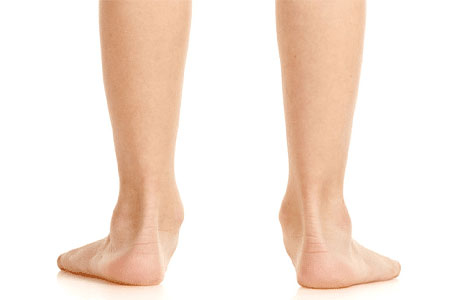
When children have flat feet, their feet collapse when they stand, and the knees and hips also become misaligned. This means the muscles that move those joints no longer work efficiently, and it will take more energy for your child to do the same work as other children who don’t have this condition.
How Can Supportive Shoes Help Children with Flat Feet?
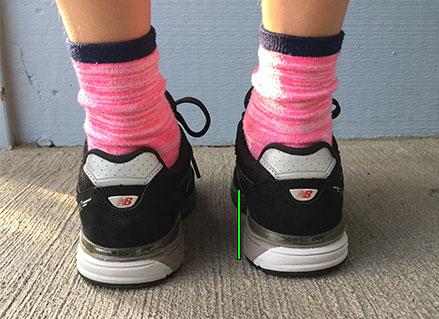
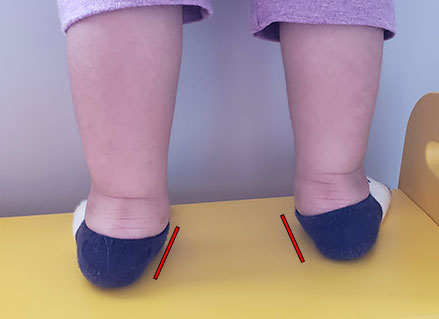
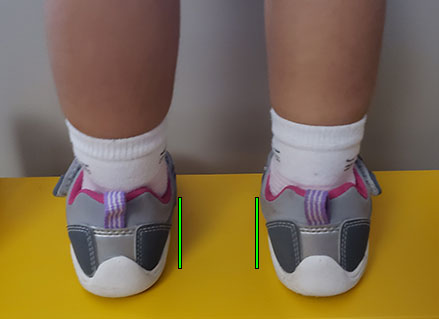
To better illustrate this, let’s take a look at a couple of pictures of children with flat feet standing barefoot and wearing supportive shoes. I have helped these children find the correct pair of shoes for their feet, and it’s pretty amazing to visualize how supportive shoes can help improve a child’s foot posture.
Example 1: A seven-year-old with flat feet and strong pronation, especially on the right foot.
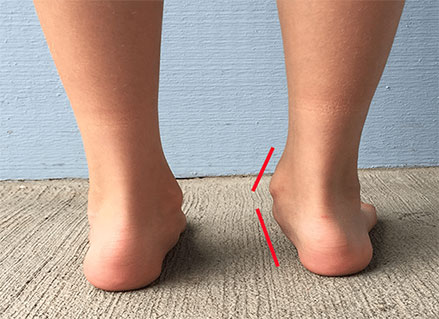
Example 2: A two-year-old toddler with moderate pronation. Barefoot, both feet collapse inward. Once fitted with supportive shoes, the feet appear straighter and more stable.
I’ve only shown two examples here, but I’ve helped hundreds of children with flat feet find the right pair of shoes over the years, and I’m confident I can help your child too.
Investing in supportive footwear and staying away from shoes that don’t provide real support (such as Converse or Vans) is a great starting point.
My Recommended Shoes for Kids with Flat Feet
I keep this list updated based on what I actually see working in the store — not just specs on a page. Every shoe below has been personally fitted on children with flat feet, and I’ve noted the pronation severity and foot width each style works best for, so you can narrow down the right pick without guessing.
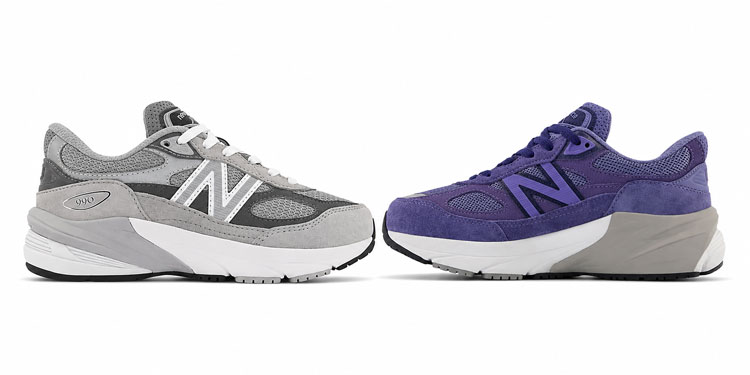
990v6 by New Balance
Best for: Moderate to strong pronation | All foot widths
My top overall recommendation for kids with flat feet. The 990v6 has an exceptionally firm midsole, a straight last, and one of the best heel counters available in a children’s athletic shoe — this is the shoe most commonly recommended by pediatric physical therapists for children with significant pronation. Main drawback: price — worth thinking of as an investment in your child’s foot development.
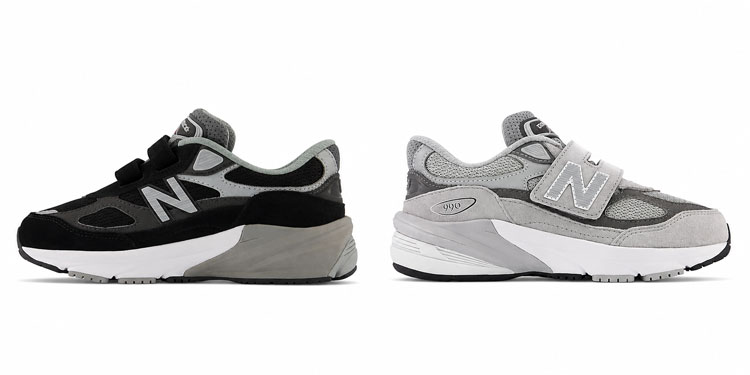
Key Features
- Available for toddlers, little, and big kids
- Order with laces on the New Balance website or Amazon
- Velcro version also available on the New Balance website or Amazon
- Firm heel counters, stable base of support, and semi-straight lasts
- Removable insoles
- Sizing tip: Order a half size larger than your child’s current foot size
Gabi and Alvin by Memo (Orthopedic Shoe)
Best for: Strong pronation | Medium and wide feet
Purpose-built for children with flat feet and strong pronation. The rigid outsole, reinforced heel counter, and double Velcro strap system provide a level of corrective support difficult to match in mainstream athletic shoes. More expensive than a typical sneaker, but medically focused — this is what you buy when standard athletic shoes haven’t been enough.
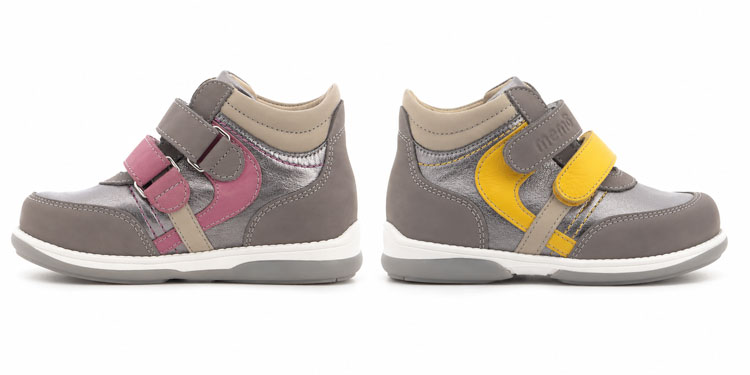
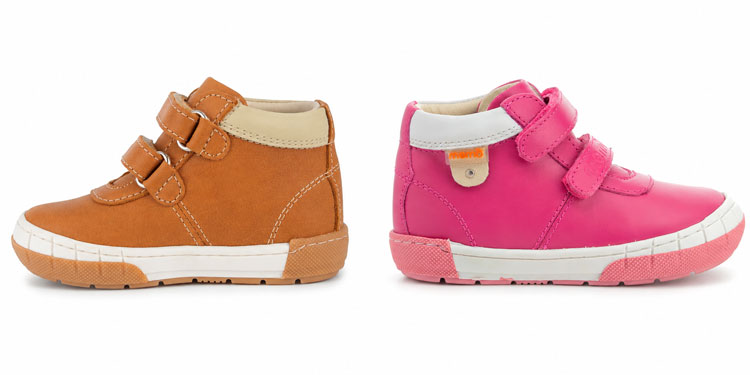
Key Features
- Available for toddlers and little kids
- Order the model Gabi or Alvin on Amazon
- Also available in a Mary Jane style and a version for older kids called Memo Polo
- High-top design with stiff heel counters
- Sizing tip: Order a half size larger than your child’s current foot size. Refer to Memo sizing chart
Elliott by Stride Rite
Best for: Mild to moderate pronation | All foot widths
A high-top bootie that wraps around the ankle, providing extra lateral stability a low-cut shoe can’t match — important for toddlers with flat feet whose ankles are still weak and collapsing inward. Affordable, easy to put on, and significantly more supportive than typical toddler sneakers.

Key Features
- Available for toddlers
- Order on Amazon
- 100% leather construction
- High-top design provides extra ankle support
- APMA Seal of Acceptance
- Sizing tip: Order a whole size larger than your child’s current foot size
Tracks by Timberland
Best for: Mild to moderate pronation | Medium and wide feet
Rugged construction and strong structural support for kids with flat feet who spend time outdoors or on uneven surfaces. The high-top design adds ankle stability, and the outsole is water-friendly for all-terrain wear. Trade-off: heavier than the others here, which may slow down very young walkers still building strength.

Key Features
- Available for toddlers and little kids
- Order on Amazon
- High-top design for extra ankle support
- Water-friendly construction
- Sizing tip: Order a whole size larger than your child’s current foot size
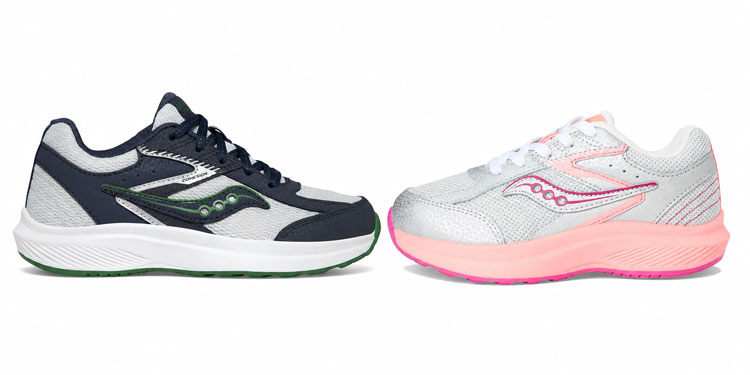
Cohesion by Saucony
Best for: Mild to moderate pronation | Medium and wide feet
The Cohesion is Saucony’s entry-level stability shoe for kids with flat feet, and it punches well above its price point. It provides good arch support and a firm heel counter — two of the most important features for flat feet — at one of the most accessible price points on this list. A particularly good starting point for families who want to try a structured shoe for flat feet before committing to a higher-priced option like the 990v6.
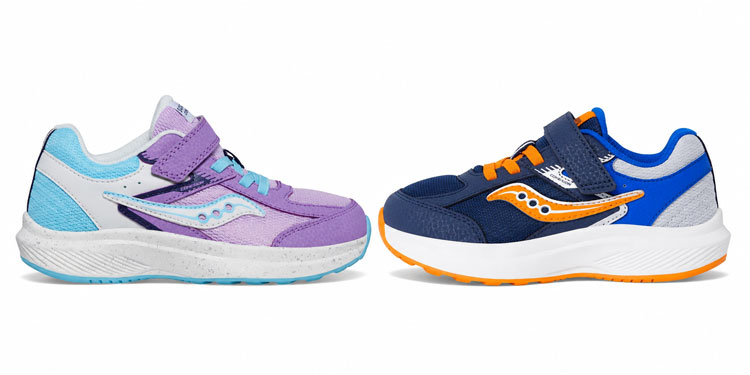
Key Features
- Available for little and big kids
- Order on Amazon
- Also available with laces on Amazon
- Firm heel counters and stable base of support
- Sizing tip: Order a whole size larger than your child’s current foot size
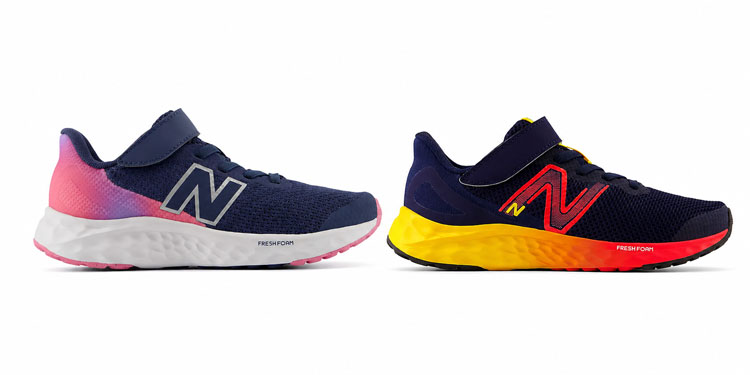
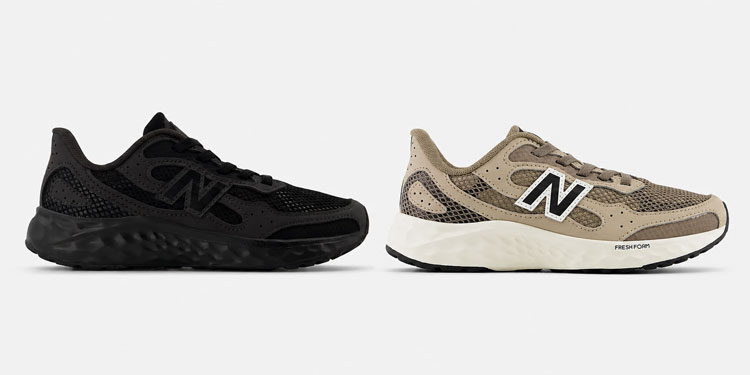
Fresh Foam Arishi v4 by New Balance
Best for: Moderate pronation | All foot widths
Some children with flat feet — especially those with sensory sensitivities — resist wearing structured shoes because they find them uncomfortable. The Arishi v4 offers a softer, more cushioned ride while still maintaining enough structure to support flat feet and manage pronation. It’s more cushioned than the 990v6 but provides better support for flat feet than most casual sneakers.
Key Features
- Available for toddlers, little, and big kids
- Order on the New Balance website or Amazon
- Also available with laces on Amazon or the New Balance website
- Semi-firm heel counters
- Sizing tip: Order a whole size larger than your child’s current foot size
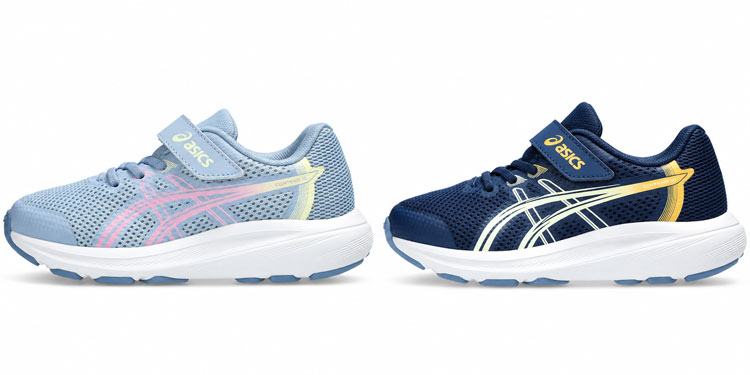
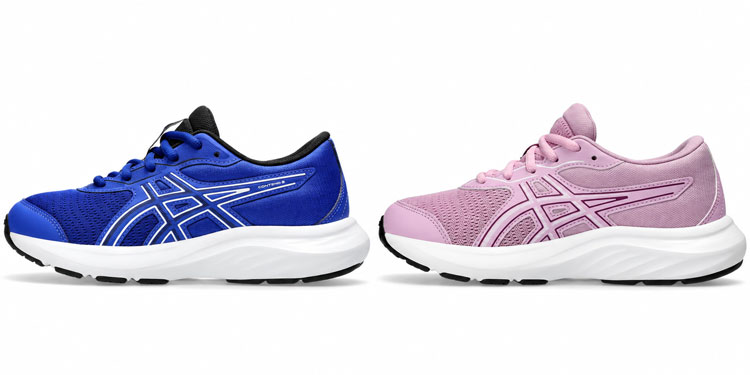
Contend by Asics
Best for: Mild to moderate pronation | Narrow or medium feet
A reliable, budget-friendly option known for its durability and support. Designed for active kids, it offers a snug fit with a narrow heel counter — a good pick for narrower-footed kids who don’t need the wider build of most shoes on this list.
Key Features
- Available for little or big kids
- Laces: Amazon — Velcro: Amazon
- Lightweight and flexible
- The toe reinforcement, toe rubber stitching, and solid rubber outsole improve durability
- Sizing tip: order a full size larger than your child’s current foot size
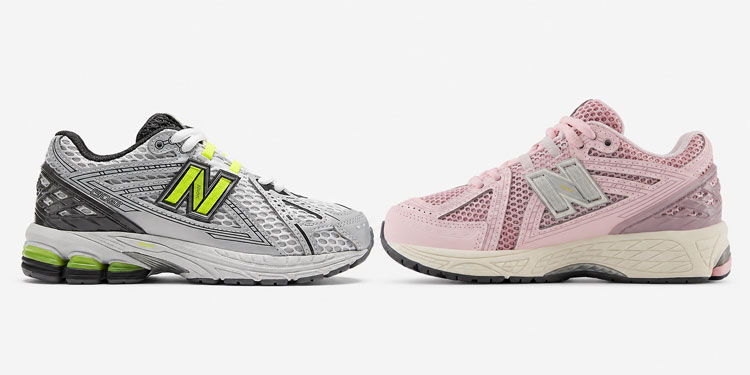
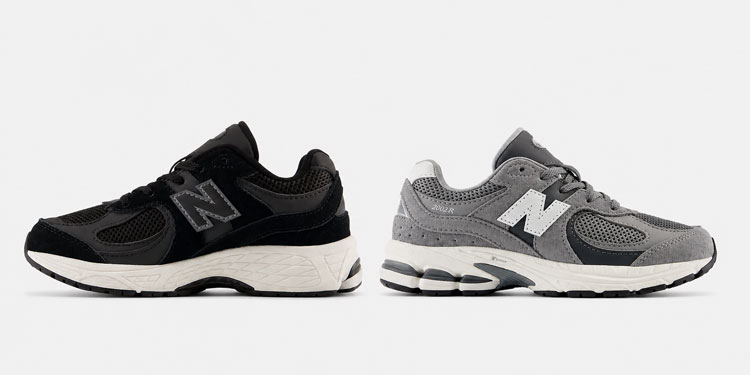
2002/1906 by New Balance
Best for: Moderate to strong pronation | Medium and wide feet
Sits between the Arishi and the 990v6 on price and support — a strong all-round option for families who want New Balance quality without the 990v6 premium. The 2002 is the primary recommendation for toddler and little kid sizes; the 1906 covers bigger kid sizes with the same support profile.
Key Features
- Available for toddlers, little, and big kids
- Order the 2002 or 1906 on the New Balance website
- Firm heel counters, stable base of support, and semi-straight lasts
- Sizing tip: Order a whole size larger than your child’s current foot size
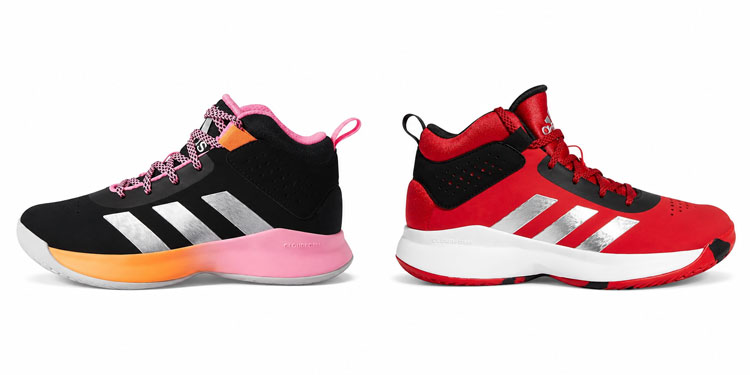
Cross Em Up by Adidas
Best for: Mild to moderate pronation | Medium and wide feet
This basketball-inspired high-top delivers excellent lateral support and a firm midsole — features that align well with what children with flat feet need during dynamic movement. It’s a great choice for kids with flat feet who are active in sports and need a shoe that holds up during running, jumping, and quick direction changes.
Key Features
- Available for little and big kids
- Order on Amazon
- High-top design for additional ankle support
- Versatile — suitable for sports and everyday wear
- Sizing tip: Order a whole size larger than your child’s current foot size
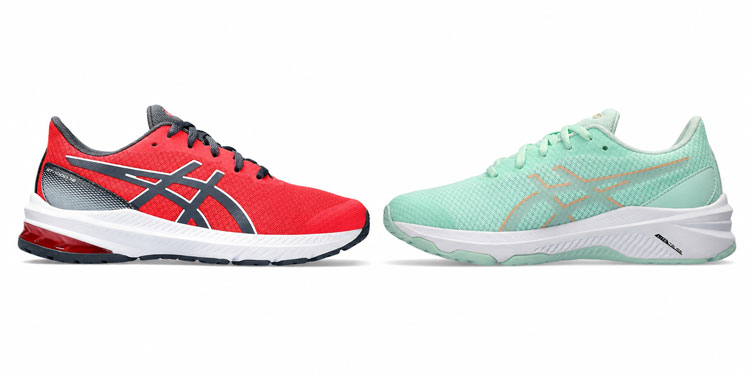
GT-1000 by Asics
Best for: Moderate to strong pronation | Narrow or medium feet
Most shoes for flat feet run wide, which is great for wide-footed kids but a poor fit for children with narrow feet. The GT-1000 is one of the few stability shoes that addresses flat feet in a narrower profile, making it the top choice for children who need flat foot support without the excess width of most structured shoes.

Key Features
- Available for little and big kids
- Laces: Amazon — Velcro: Amazon
- Firm heel counters, stable base of support, and semi-straight lasts
- GEL technology: Improves impact absorption and creates a softer feeling at footstrike
- Sizing tip: Order a whole size larger than your child’s current foot size
Disclosure: some links above are affiliate links — we may earn a small commission at no extra cost to you.
Get in Touch for a Personalized Shoe Recommendation
Every child’s feet are different, and the right shoe for one child may not work for another. Contact me by email or leave a comment below — based on your child’s foot shape, shoe size, and specific needs, I can recommend supportive shoe styles most likely to improve their comfort and foot posture.
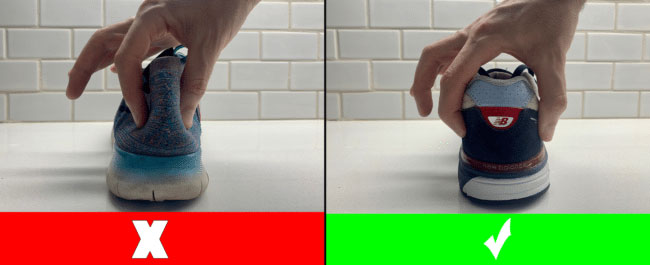
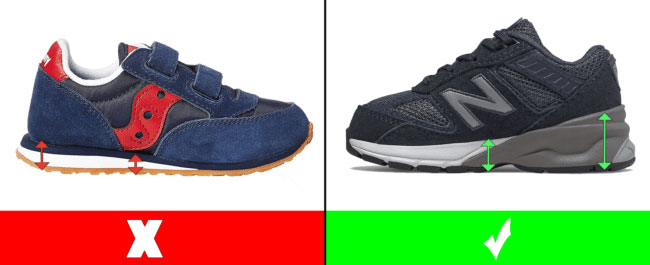
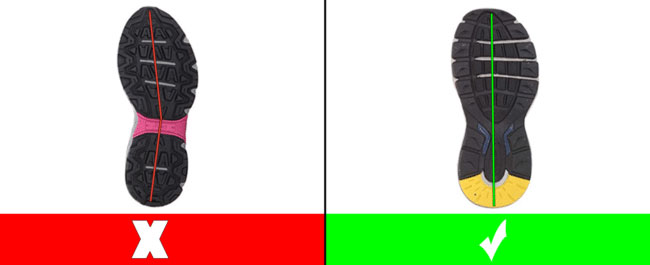
What Makes These Shoe Recommendations Ideal for Flat Feet?
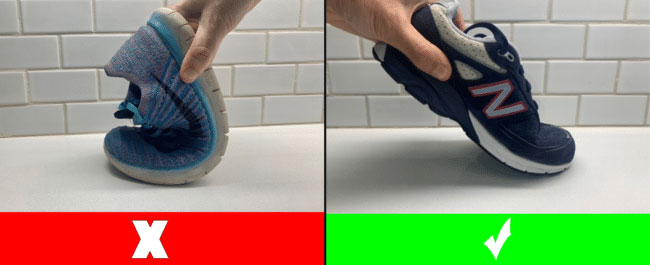
Selecting the Right Size and Fit
Choosing the correct shoe size for kids with flat feet is essential — shoes that don’t fit right only make the condition harder to manage. Shoes that are too tight can worsen flat foot issues; shoes too loose can cause instability. Since most specialized children’s shoe stores have closed, I created a virtual shoe fitting service to help you order the correct shoe size online, including whether your child has narrow, medium, wide, or extra wide feet.
Is It Normal for Toddlers to Have Flat Feet?
It’s normal for children below age 4 or 5 to not have their arch fully developed — but that doesn’t mean the condition should be left untreated. Children under age 5 typically don’t have pain or complain, but they still have a treatable condition.
Not all flat feet are the same, and depending on severity, you might need to intervene earlier. See Toddler with Flat Feet for guidance on the right timing for supportive shoes specifically for toddlers.
If your child wears any of the shoes recommended here for four to five months and the pain hasn’t significantly reduced or resolved, your child might be a candidate for orthotics.
Orthotics for Kids with Flat Feet — Extra Support and Stability
Children with flat feet dealing with strong pronation and severe foot or leg pain might need an orthotic fitted inside the shoe for extra support and stability. The correct orthotic helps your child walk and run straighter by aligning the feet and legs and reducing the stress they’re putting on their feet. See Orthotic Inserts for Kids with Flat Feet for two over-the-counter options that provide excellent arch and heel support without being as invasive as other orthotics.
Supportive Shoes for Kids with Flat Feet — Watch My YouTube Video
I put together a video walking through the key features your child’s shoes should have to support healthy foot posture and improve walking gait.
Distinguishing Between Flexible and Rigid Flat Feet
It’s essential to differentiate between flexible flat feet, where the arch appears when on tiptoe but flattens when standing normally, and rigid flat feet, where no arch is visible even on tiptoe. Flexible flat feet are more common and generally less concerning, often resolving with growth. Rigid flat feet may require medical evaluation, since they can be associated with underlying structural issues.
Is It Normal for Children to Complain About Foot or Leg Pain?
Foot and leg pain is never normal. If your child complains consistently, it may be a sign of a foot condition like flat feet. Flat feet are usually hereditary — one of the parents has them, or they run in the family.
It’s important to note that pain isn’t the only reason to treat flat feet. Left untreated, flat feet can produce a problem later in a child’s life — it might not be in the foot; it could be the knee, hip, or back. Every structure and joint above the feet depends on the feet.
Frequently Asked Questions About Kids with Flat Feet
For most of the day, yes — children with flat feet benefit from supportive shoes, especially during walking, school, and play. It’s fine to let your child go barefoot at home for a few hours a day (around 3–4 hours), as long as they’re on safe, flat surfaces.
In many cases, supportive shoes alone are enough — especially for mild to moderate flat feet. I recommend starting with the right shoes first and monitoring the response. If there’s little improvement or pain continues after several months, that’s when orthotics may help.
No. In younger children — especially under age five — flat feet are usually not painful and often part of normal development. In older, more active children, flat feet can sometimes lead to foot, leg, or knee discomfort from increased impact and strain. Every child is different, so ongoing pain is worth discussing with a medical professional.
This comes up often, and it’s a genuinely reasonable question. Whether kids should wear minimalist shoes that mimic being barefoot, or shoes that provide real support, has been debated for years, with valid arguments and evidence on both sides. Based on over a decade of fitting and testing shoes, I recommend more support rather than less for a child already dealing with flat feet specifically — the correct supportive shoe, fitted correctly (right length and width), can meaningfully realign the feet and improve posture. Minimalist shoes work well for some people and some conditions, but in my experience they’re not the right starting point for a child whose flat feet are already causing pain or visible collapse.
If your child’s pain is severe, worsening, or impacting daily activities, it’s a good idea to consult a pediatric foot specialist or healthcare professional for personalized guidance.

Hi! Thank you for all this helpful info! Hypermobility runs in the family and I recently noticed my 6 year old has flat feet and tight calf muscles by the evening. He walks completely barefoot at home (on tile/wood). We’ve failed many attempts to get him wearing shoes at home– any recommendations for comfy shoes for home use on weekends etc? Are birkenstocks any good?
Hi Maddy! I’m glad you found the information helpful.
For wearing around the house and on weekends, I would recommend trying the Teva Hurricane. It’s easy to get on and off, comfortable for everyday wear, and provides a good combination of cushioning and support. It also feels less restrictive than a regular sneaker, which might make it easier for your son to transition from being barefoot at home.
Another good option is the KEEN Newport. It provides a more substantial and stable base of support and is a great choice for children with flat feet, although it does feel a little more structured and heavier than the Teva Hurricane.
As far as Birkenstocks are concerned, I tend to view them more as casual/dress footwear rather than something I would choose as a supportive house shoe for a child with flat feet, especially if your son is already experiencing tightness or discomfort by the end of the day.
I hope this helps, and please let me know if you have any other questions!
Thank you for this I just found out my daughter has flat feet since she has complained about pain and xray confirmed it. Can you help me find a good sandal/slipper for at home and also a good basketball shoe please for an 8 year old. Thank you again
Hi Stephanie,
I am happy to help. Please share your daughter’s foot shape (narrow, medium, wide, extra wide) and shoe size, that way I can recommend shoes that accommodate your daughter’s foot shape correctly.
This is so helpful. Do you have any recommendations for soccer cleats for big kids (size 4.5) with flat feet and pronation? My daughter complains about wearing her heel inserts with cleats because the shoes are usually so narrow and low cut. .
Yes, that’s a common complaint — soccer cleats do tend to run narrow and low-cut, which makes fitting orthotics or heel inserts tricky. For a kid with flat feet and pronation, you want a few things: a firm, structured heel counter to keep the foot from rolling inward, a roomier toe box and midfoot for depth, and ideally a slightly higher collar for support.
The style I recommend is 442 by New Balance, which also comes in wide widths — that extra width usually solves the “no room for the insert” problem without sacrificing the support she needs. This model might work as well but it’s less supportive Tekela Team Low
Hope that helps!
so helpful thank you!
I’m really glad you found it helpful. My goal is always to make it easier for parents to understand what shoe features can best support their child’s feet.
Are your shoe recommendations meant to be worn with orthotics?
Hello Lisa,
The shoes I recommend are great for children with mild to moderate flat feet and can even help manage stronger pronation without the need for orthotics.
If your child needs to wear orthotics, most—but not all—of the recommended models can accommodate them. Let me know if you want help picking the right ones!
Hola buenos días crees que me podrías ayudar con encontrar el zapato adecuado para el pie de mi hijo
Hola Lizette,
Sí, mándame un correo electrónico con la forma del pie de tu hijo (estrecha, regular, ancha o extra ancha), la talla que usa y el país desde el que me estás contactando, para verificar qué zapatos podrías ordenar para tu hijo. También sería importante saber si tiene algún dolor en los pies o en las piernas.
Puedes enviarme el correo a esta cuenta: customerservice@fittingchildrenshoes.com
Hi! Are the Dynasoft Reveal V4 BOA by New Balance good for flat feet? thanks!
Hello Novella,
I don’t recommend that specific model for children with flat feet as it’s not supportive enough. Let me know if you have any other questions.
Thanks for your reply! My son has flat feet, but luckily he doesn’t complain of pain and his feet are not turning inward nor collapsing in a noticeable way.
He is 5 years old, wears size 11 and his feet width is 2.55 inches. We live in Québec, Canada. We bought him a pair of Geox Flexipair Fast, and we need a second pair for school. Can you suggest few models? Are Geox generally a good choice for him and what about tbe Flexipair we bought? Thank you in advance for you time and help!
Hello Novella,
I’m so glad to hear that your son isn’t experiencing any foot or leg pain! Keeping him in shoes with a stable base and firm heel counters is key to maintaining that support.
Unfortunately, I’m based in the United States and don’t have direct access to Canadian shoe availability. That said, Geox is an excellent brand for children with flat feet—many of their styles offer supportive outsoles and firm heel counters that can really help.
Feel free to continue our conversation via email! I’d be happy to review the specific pairs you’ve purchased and let you know if they’re a good fit for your son’s feet.
Do you have any recommendations for flat feet shoes that Leo have a wide toe box? All of these seem pretty narrow to me and I’d have to solve one problem and create another. Thank you!
Hello Anna,
Absolutely! Most of the shoes I recommend are available in wide and extra wide widths, and I’d be happy to recommend the best options specifically for Leo. Just let me know his shoe size and the country you’re reaching out from—that way, I can tailor my suggestions to what’s available and most suitable for his feet. Looking forward to helping you find the perfect fit!
Thanks! Size is 9 medium. US, Colorado.
I suggest the following models for Leo:
Option 1 I selected the shoe size 9
Option 2 I selected the shoe size 9 wide as the shoe has a narrower toe-box
Option 3 I selected the shoe size 9
Let me know if you have any other questions.
My daughter is 6 and her feet are still flat, she doesn’t complain. Should I go back to the podiatrist? I have only take her before over ingrown toenail.
Hi Carey,
If she’s experiencing stability problems or foot pain, it’s definitely a good idea to consult a medical professional. They can provide personalized advice and might recommend supportive shoes, orthotics, or a combination of both to help her feel more comfortable and steady on her feet.
My son is flat foot and valgus deformity heel I need the best shoes for him
One for football training
And one for the school
I need the best shoes
Thank you
Hello Hassen,
To recommend specific shoes for your son I first would need to know your son’s foot shape (narrow, medium, wide, extra wide), what shoe size he wears, and the country that you are contacting me from to check what specific shoes you might be able to order.
For the school shoes, do they need to be made of a specific color?
Any big kid(size 5) hook & loop shoe recommendation please? My autistic son has pronation & also cant lace up yet.
Hello,
Yes, there are some options available. However, I first would need to know your son’s foot shape (narrow, medium, wide, extra wide), and the country that you are contacting me from to check what specific Velcro shoes you might be able to order.
You can also provide me this information via email: fittingchildrensshoes@gmail.com
What do you recommend for shoes as kids start hitting adult sizes? My son has flexible flat feet and extreme pronation and we’ve been following your recommendations for years and it has helped him so much. However, he’s turning 13 soon and is now outgrowing children’s shoes and needs adult sizes for everyday sneakers and basketball sneakers.
Hello Katie,
If you tell me your son’s foot shape (narrow, medium, wide, extra wide), the shoe size that he needs, and the country that you are contacting me from I am happy to provide you with specific shoe recommendations. You can either respond to my comment or if you prefer we can communicate via email: fittingchildrensshoes@gmail.com
Plat foot problem sir one year baby left foot
To recommend specific shoes for your child I first would need to know your child’s shoe size, foot shape (narrow, medium, wide, extra wide), and the country that you are contacting me from to check what specific shoes you might be able to order.
My daughter has down syndrome, and I’m looking for the right shoes for her feet. Can you help?
Hello Nicole,
Sure, I think this is a good place to start: How to Measure Your Kids’ Foot – 2 Simple Steps to Determine Foot Length and Foot Width
Once I know your daughter’s exact foot shape (narrow, medium, wide, extra wide, high insteps), and foot conditions (flat feet, overpronation, etc.), I will be able to recommend specific shoes for her feet to improve foot posture, balance, and gait.
I wish I would have found you years ago. My son is about to turn 8 and no one ever said his feet do this because they are flat feet. I would have looked it up. We have went to probably 4 therapist and he had braces for 2 years and his ankle look like the pictures above.Finally a therapist said it’s a combination on flat feet and he is hyper flexible at the same time. I am so grateful to have found you. You are changing lives. Thank you
Hello Katie,
Thank you for your kind words. I hope your son’s foot posture and walking gait has improved now.
Do you have a recommendation for a flat footed early teen to correct pronating in a school shoe (leather style shoe) not a trainer. Please, your advice seems very sensible.
Hello Lousie,
To recommend specific shoes for your child I first need to know what shoe size he/she wears, the foot shape (narrow, medium, wide, extra wide), and the country that you are contacting me from to check what specific shoes you might be able to order.
You can also contact me via email: fittingchildrensshoes@gmail.com
Would these work for flat footed child? Is it any saucony or new balance that are good or only a few styles?
Saucony Unisex-Child Peregrine 10 Shield Sneaker
Hello Robin,
I usually don’t recommend specific shoe brands as there are specific models among each shoe brand that work a lot better than others.To answer your question, that specific Saucony shoe style that you like will work well as long as your child is dealing with a mild to moderate degree of pronation.
Hello,
My name is Julia Ortiz. I invest in online projects and buy websites. Your website fittingchildrenshoes.com is interesting to me and I want to buy it. Or maybe there are some other websites, you can also share info about them, so I can explore other offers. If my proposal interests you, please answer me here: webinvest108@gmail.com.
Thank you, have a good day!
Kind regards, Julia
Hello Julia,
For inquiries like this please contact: customerservice@fittingchildrenshoes.com
Hello, thank you for your support and informative website. I had no idea! My son is 9, and has just started complaining about foot pain, but I realized he always complains (and we cut our walks short because of him) when we go for walks or hikes. He started walking funny about 6-9 months ago, swinging his arms back and forth and walking “cave man” style, like his whole body swings from one side to the other. I wondered about it, but it’s gotten worse, and he has knocked knees and flat feet. We have been using the shoes Plae with velcro closure for sometime, and just stopped using them as we started to have some quality issue with the last few we purchased.
My question is, do we need to seek help to address his swaying walk and knocked knees, or is starting with supportive shoes be a first step?
My son’s foot measures L: 8.75″, by W: 3.75″
What tennis shoes would you recommend for him, and he also lives in Chacos sandals during the summer, are those OK to use for him?
Hello Sean,
It seems like your son’s foot condition (flat feet) is interfering with his daily activities, so it might be best to visit your medical professional.
With that said, making sure that your son wears supportive shoes should be the first step to prevent his foot pain. If after wearing supportive shoes the pain persists, then he might be a candidate for orthotics.
I can’t recommend specific shoes without knowing your sons’ foot shape (narrow, medium, wide, extra wide, high instep). You might want to take a look at this free resource: How to Measure Your Kids’ Foot – 2 Simple Steps to Determine Foot Length and Foot Width
Chacos are fine, but you might want to look into a more supportive style such as the Keen Newport or Teva Hurricane
Thank you Juan, I really appreciate it. I will send you his photos to measure his feet so we can get a recommendation on style and size- thank you! I will also discuss this with his dr and see if anything else can help him. Truly appreciate your efforts!
I am happy to help.
Hi Juan. This is one of the best informative websites about children’s flat feet I found. Thanks for sharing your knowledge.
My daughter is turning 8 in November and has flat feet with valgue heels, specially visible on the right feet. I haven’t checked the size and width of her feet (how do I check these info?). I’ve taken her to a consultant podiatrist when she was about 3 or 4 but they haven’t taken any preventive action or recommended any specific shoes/orthotics, so I’ve tried to give her orthotics as much as possible over the years, although it has not been corrected. I would like an opinion about this kind of insole please https://amzn.to/3meGm76 and about this solution to wear at home/garden since she’s always with bare feet/ or also inside school shoes???
Also, in terms of sport, is ballet a good sport to correct flat feet? I read that sports that involve bare feet (ballet/ martial arts..) are good to strengthen the feet’s muscles so should encourage developing stability (also roller skating/rollerblading as it strengthens the toes). I’d like to hear your opinion please?
Ps. this is the second link I’d like to ask an opinion about, when having bare feet…: https://amzn.to/3KKOTJu (most of this kind of solution have only 3 1/2 star review..)
Many thanks!
Hello Laura,
I am glad you find the website informative.
Whether the Alikaka insoles that you showed me in the first link will work for your daughter’s feet directly depends on the degree of your daughters’ flat feet and pronation. That type of insole will work well if your daughter has a mild degree of pronation. If your daughter has moderate or strong pronation then I suggest that you look into a different type of insole/orthotic.
In my experience, children who are 5 years old or older and have not developed an arch will remain flat footed for the rest of their lives. The goal is to allow the child to live his/her life without foot or leg pain, and one of the ways to accomplish this is by wearing supportive shoe and/or orthotics.
I don’t have any experience with the products in the last two links that you sent me, so I can’t tell you whether they might help or not.
To retrieve your daughter’s foot shape you can use this free resource that I created: How to Measure Your Kids’ Foot – 2 Simple Steps to Determine Foot Length and Foot Width
Hi Juan,
you have a great website, thank you for sharing your wisdom ! my son is 4 and 1/2 , he has flat feet and high In step. he is very clumsy and falls a LOT ( I literally buy few new pants every 2 months ). I really want to help my son and keep him safe. I bought him new expensive Geox that seemed great for high instep and very sturdy, a couple of months ago. he still is falling a lot and has pocked 2 big wholes in the front of the shoes I honestly don’t understand how…long story short, I’m looking for a new, every day, sturdy, pair of shoes that can help his balance and at the same time be tough enough to last for a busy active little boy like him. the best I could found based on reviews so far was Keen little chandler CNX and Merrell Trail chaser , and then I found your website and you mention the new balance . However the new balance you recommend for flat feet have laces and no velcro and this is impossible for my toddler his is way too young for laces. could you help me please ? thank you
Hello Meriem,
I am happy to help. I noticed that you also sent me an email so I will continue our conversation there.
Hi,
My son is 7 years old he have flat feet . He wear size 36 size shoe . We are in Qatar . Can you recommend a pair shoes for him. running shoe and slipper for indoor also.
Hello Nippy,
Is your son experiencing any foot or leg pain?
In order to recommend specific shoes for your son I first need to know whether his feet are narrow, medium, wide, or extra wide. If you are unsure of your son’s foot shape please follow the instructions here: How to Measure Your Kids’ Foot – 2 Simple Steps to Determine Foot Length and Foot Width
Hi Juan
Foot pain only when he is doing cycling or running .
his feet size 23.5cm(Length)and 9.2cm(width)
Hello Nippy,
Thank you. The width measurement won’t help me determine your son’s foot shape or instep height, so I will need an image of the front part of your son’s feet. I will show you how the image should look like. Send me an email to the address below so I can show you how the image should look like:
fittingchildrensshoes@gmail.com
Thank you so much for your suggestions. The podiatrist is the one that had him in hiking boots and just recently told him he could go to high tops. The high tops he suggested were all Nike Jordan shoes with a thick sole. He said he needed a strong support shoe because he was able to change the shape of the shoe so easily. We are trying to avoid surgery in the future, if possible, by recorrecting the feet now. I saw that your suggestions on the page were not high tops and that is why I reached out for your advice. Thank you again for your time and knowledge. We greatly appreciate it.
Hello Leslie,
The high top shoes that I recommended provide firm heel counters and substantial outsoles.
Nike is a very popular brand name but their kids’ shoes aren’t among the most supportive ones.
Thank you for your information, it has been a great help. My son wears a 5.5 big kid and has a normal width. He has inserts for the fallen arches and weak ankles. He has been in hiking boots and was just recently able to move to high tops. Can you recommend any good high tops with ankle support and heel support? Thank you in advance for your assistance
Hello Leslie,
Keep in mind that high top shoes don’t necessarily provide better ankle or heel support than regular sneakers. If you want to provide your son with a pair of high top shoes I recommend the ones below:
Option 1
Option 2
Make sure that your son’s shoes are properly tied at all times so he can get the full support and stability that the shoes have to offer.
Do you have any available stores in UK?
Hello,
No, but I can help you figure out your child’s foot length and shape here: How to Measure Your Kids’ Foot – 2 Simple Steps to Determine Foot Length and Foot Width
I can also help you find the correct pair of shoes for your child online.
Hello,
Our 19 month old son was diagnosed with flat feet a few months ago, we have seen a pediatrician, a orthopedic and a physiotherapist. They didn’t mention anything about our son should wearing ‘special’ shoes. We were told to do nothing and wait but his condition is getting worse. He has been wearing only soft shoes and reading your article this will not help, we have been told his current shoes are fine. Can you please recommend some trainers for our son or similar? He has a wide feet and a high instep.
Thank you
Hello Agnieszka,
I am happy to help. Can you tell me from which country you are contacting me from? This will help me check what shoes are available in your area. Please send me an email at fittingchildrensshoes@gmail.com
Hi Juan , my son is 12 years old he have flat feet . He wear size 5 shoe . We are in Canada and alots of snow . Can you recommend a pair of snow boot , a running shoe and a pair of slipper for indoor please ?
Thanks
Hello Adam,
In order for your son to get the full stability and support that the shoes have to offer, the shoes need to be fitted correctly. So, before I can recommend specific shoes for your son, I first need to know whether his feet are narrow, medium, wide, or extra wide.
What about big boys sandals for flat feet
Hello Rene,
It depends on your child’s foot shape. Do you know if your child has narrow, medium, wide, or extra wide feet? In addition, are you looking for an open toe or closed toe sandal?
I just wanted to congratulate you for such informative posts! Have 3 kids and I have learned so much from you! Cannot thank you enough and have bought them much better shoes thanks to you!!
Hello Sonia,
I am really happy to hear that! I will be here to answer any questions that might come up so don’t hesitate to contact me if you have any questions.
Hi Juan,
What tennis shoe do you recommend for a child with hypermobility in the feel and narrow heels, but wider isn’t he toe? Boys. Thank you.
Sorry for the auto correct typos. My children have hypermobility, and narrow feet that are wide in the toe box. What would you recommend? They are boys. Thanks.
Hello Eliza,
I am happy to help but make sure that you order the shoes in the correct size or your boys won’t get all of the benefits that the shoes have to offer. If you are unsure of your boys exact foot length and width please follow the instructions on this article:
How to Measure Your Kids’ Foot – 2 Simple Steps to Determine Foot Length and Foot Width
As far as everyday sneakers concern, below you can find some of my recommendations:
Option 1
Option 2
Do your boys wear orthotics with their shoes?
I suggest that you apply this shoe lacing technique:
How to Tie Shoes for Kids with Narrow Feet – Make their Shoes Fit and Feel Better!
Let me know if you have any other questions.
Hello Juan!
My daughter is 14 years. She has a flat feet. What sneakers and shoes would you recommend, her size shoes in ASICS is 7.5 as she is a teenager, that’s makes difficult to
find a shoes that likes her.
Hello Lilian,
Is your daughter experiencing any foot or leg pain? It seems like your daughter is wearing women’s shoe sizes. I can definitely recommend specific shoes but before I send you specific shoe recommendations I need to know whether your daughter has narrow, medium, wide, or extra wide feet. I also need to know wether your daughter has a high instep or not. You can follow the instructions in the article below if you are unsure of your daughter’s foot shape:
How to Measure Your Kids Foot – 2 Simple Steps to Determine Foot Length and Foot Width
Feel free to reach out to me at my email address: fittingchildrensshoes@gmail.com
Juan,
Thank you again for the boot recommendations.
Another question if you don’t mind,
below is the shoe Mobley’s Shoe store recommended since I was in search for uniform shoes for my daughter that would provide support for flat feet…Would you recommend this shoe?
https://amzn.to/3ZqCJt9
Thank You in advance
Hi Zelda,
Yes, I have fitted that specific shoe that you are referring to and it provides good support. In certain cases of children with flat feet we had to fit an orthotic inside that shoe for additional support, which is totally doable as that specific Mary Jane style is deep so if you remove the original insole you can fit an orthotic inside. If you decide to fit an orthotic inside that shoe I will guide you through the next steps. You can contact me at my email address fittingchildrensshoes@gmail.com
When I click on the link for the inserts for older kids, it takes me to an amazon page for socks, FYI.
Hi Lauren,
This has been fixed. Thank you so much for letting me know.
Hello,
Are there any soccer cleats that you would recommend? For an 11 year old boy with narrowish feet. Size 4.
Hello Gaurav,
Yes, the soccer cleat I recommend can be found in this article:
Narrow Soccer Cleats – The Best Soccer Cleats for Children with Narrow Feet!
If your child experiences foot pain during soccer games or practices then you should consider fitting an orthotic inside the cleats for extra support. For more information on that specific topic go to the article below:
Sport Insoles for Kids with Foot Pain – Support Your Child’s Feet and Prevent Pain!
I hope this helps.
Looking for shoe school for my 11yr who flat footed any recommendations
Would be very helpful
Hi Samantha,
There are certain school shoes that provide better support than others. Does your son wear an orthotic inside his sneakers?
Before I can recommend specific shoe recommendations I need to know your son’s exact foot shape. Do you know if your son has narrow, medium, wide, or extra wide feet? If you don’t know I suggest that you take a look at this article:
How to Measure Your Kids Foot – 2 Simple Steps to Determine Foot Length and Foot Width
You can also contact me via email at fittingchildrensshoes@gmail.com
Hello, I was wondering which New Balance shoe you would recommend for children in the UK as those listed above aren’t on the UK site? My son is 3, a shoe size 10 and he has flat feet and overpronation. I have looked at the New Balance site and seen the 574 style or 997H and am unsure which to go for?
Hi Kimberley,
I have spoken with several other parents from the UK who ran into the same issue. You should write me directly to: fittingchildrensshoes@gmail.com and I will try to send you specific shoe recommendations.
Hi I just ordered some snickers for my grandson because he has flat feet i was wondering if you guys have also shoes. Thank you
Hi Ana,
Are you looking for a pair of dress shoes for your flat footed grandson? There are certain styles that provide better support than others but I suggest limiting the wear to no more than 4 hours a day. I can send you specific dress shoe recommendations but I need to know whether your grandson has narrow, medium, wide, or extra wide feet. You can write me to: fittingchildrensshoes@gmail.com
I grew up wearing very supportive shoes and was fitted with orthotics due to flat feet. My husband has had foot problems as well with bunions. I began looking into ways to help correct both of our problems and my research led me to barefoot friendly shoes, meaning no arch support, wide toe box, zero drop from heel to toe. Both of us are now pain free, I have an arch and his bunions are almost entirely resolved. I am wondering if you can direct me to any research about more support vs less when it comes to feet issues.
Hi Elizabeth,
I am glad you and your husband are now pain free.
Whether kids should wear sneakers that imitate their feet being barefoot or wear sneakers that provide support is a discussion that has been up for debate for many years. There are valuable arguments and different sorts of views and actual evidence to support both claims.
The type of shoes I recommend are based on my 10 years of shoe fitting experience. I have been testing and trying different shoe styles and some are more effective than others. When it comes to treating the shape of a child with flat feet I always recommend more of a shoe instead of less. Supportive shoes can make a tremendous difference for a child who is dealing with flat feet and foot or leg pain.The correct type of shoes can help realign the child’s feet and improve the child’s overall posture, as long as they are fitted correctly.
How effective the shoes will be depends on each child’s foot anatomy.
You mentioned how you grew up wearing supportive shoes and orthotics. There are many factors that may have contributed to the shoes and orthotics being ineffective in your specific case. Not all supportive shoes and orthotics are effective in treating a child’s foot condition, only specific styles. It’s also imperative that the shoes are fitted correctly — correct length and width —
I hope this clarifies.
Hi Juan.
I hope you can advise me on footwear for my children.
My 6 year old daughter has juvenile Idiopathic arthritis in her right foot and has flat feet. She has orthotic insoles for her shoes. Are there any sandals you can recommend. She is desperate to be like everyone else! She is size 12 wide.
My son is 4 with extremely flat feet. He also has orthotics and walks on tip toes. He is size 10 narrow. Any advice on footwear or general advice would be great.
Regards
Natalie
Hi Natalie –
I hope you are well and staying safe.
For your daughter with idiopathic arthritis and flat feet there is a specific sandal that provides a substantial sole and will prevent her feet from collapsing. Please find my recommendations below:
Sandal for Flat and Wide Feet
It has to be that particular style, the other Keen styles are not as supportive. Keen is having a promotion right now so the sandals should be 25% off.
For your son, assuming that he is wearing the correct type of orthotics, we need a sneaker that is going to help “ground him”. The shoe needs to be harder to bend at the front in order to prevent him from getting on his toes and shoelaces instead of velcro closure, as this factor also plays a role in preventing him from toe-walking. Please find my recommendations below:
Sneaker for Toe-Walking: Option 1
Sneaker for Toe-Walking: Option 2
How to Tie Shoes for Kids with Narrow Feet – Make their Shoes Fit and Feel Better!
That article is also going to show you a shoe tying technique for kids with narrow feet.
I hope this helps.
Hi Juan –
My son has developed bunions in one of his feet as well as Plantar Fasciitis from having flat feet. Our pediatrician told us that he will outgrow the issue by the age of 5, but he is 7 years old now and keeps walking with his feet inwards, which is also having an impact on his posture. My husband and I wished we have addressed his foot condition earlier. Can you please recommend a pair of sneakers as well as orthotics?
Hi Nairobi,
It’s important to start caring for your child’s feet from an early stage in order to avoid future foot, leg, and lower back issues. Before I can send you specific shoe recommendations I need to know your child’s foot size and whether he has narrow, medium, wide, or extra wide feet.
Hi Juan, I am happy to find your blog, my story began this way, my son start standing when he was 10 months he used to push him self up to stand, he was crawling using his feet without the knee (knee up). We decided not to put him on shoes and we were letting him barefoot most of the time. The boy loves to run since he knew how to walk but also fall a lot which I though normal and somehow I feel he is clumsy as with no reason he fall unexpectedly. Just running alll day (till now and he is 4 years old) We had new balance first shoes when he turn 18 months. My husband keep on telling me we need to check him for his feet because he feared he will walk like him on the inside. ( my husband is not flat feet but he walk like one) I told him our son stand like you and I though it’s a geins. But then almost reaching the age 4 he stared to complain about a pain in his right feet only and I thought it’s just because the way he kicks the ball (sliding his toes on the ground). The pain comes and goes every 2 weeks. It wasn’t constant, I decided to take him to the orthopedic and he told me my worst nightmare that he is flat feed and he has X shape legs. And gave us an insole and he should wear it all the time but also he mentioned about an operation?? in the future. I don’t know how and when but I am freaking out. I am searching for house shoes, just ordered those insole for the socks. And I don’t know what to do I wish you could advise me. Dose that mean he can’t do sports? I am heart broken and also overwhelmed with all the information in the internet.
Please advise,
Thank you and regards
Khole,
First of all, being flat footed is more common than you think. I have seen hundreds of flat footed children and they are able to perform everyday activities and engage in sports such as other children with normal arches are.
The issue with being flat footed is that it can lead to foot and leg pain, and lower back problems in the future if left untreated. However, your occupational therapist already provided you with a pair of orthotics, which if they are worn with the correct pair of shoes they will significantly reduce or fully eliminate your child’s pain and allow him to walk and run straighter.
Please keep in mind that your child needs to wear the correct pair of shoes in order for the orthotics to be effective. You can send me a picture and a video of your child walking with and without shoes to my email: fittingchildrensshoes@gmail.com
When you mention that your son has X shaped legs do you mean that he has bowlegs? This is also referred as knock knees. Please clarify.
The goal here is to try to avoid surgery.
I am looking for a children size 2.5 for myself. I am not flat footed but I do need an insert for arch support..any suggestions?
Hello BJ,
We need a shoe style that comes with a substantial sole, provides a firm heel counter and extra depth so the insert can fit perfectly inside the shoes. Please find below my recommendations:
Shoe with Support and Extra Depth: Option 1
Shoes with Support and Extra Depth: Option 2
Both of these shoe styles are available in wide and extra wide widths. Please let me know if you have any questions.
Hello My son is 4 and has extra wide flat feet he runs between 12 & 13 depending on the shoe and complains about a lot of them hurting wondering if you have any suggestions. Thank you
Forgot to say he is really big for his age and I prefer the Velcro since he destroys shoe laces as well
Hello Marci,
The styles that I sent you are available with Velcro closure.
Hello Marci,
I can provide you with some Velcro closure recommendations, but keep in mind that shoes that come with shoelaces provide better support and stability. Below you can find my recommendations of the most supportive kids’ shoes that are also available in extra wide widths:
Supportive Shoe for Boy with Extra Wide Feet: Option 1
Supportive Shoe for Boy with Extra Wide Feet: Option 2
I hope this helps!
Hi Juan! My son has flat feet, wide feet and pronation. He is wearing size 10. Can you please recommend some shoes with no lace?
Thanks,
Hi Bess,
Please keep in mind that shoelaces provide more support and stability than Velcro closure. Below you can find my recommendations:
Shoe for Pronation and Wide Feet: Option 1
That shoe style is also available in grey and black.
I hope this helps!
Very helpful information!! My son is 8 and is always saying his feet hurt. I already have him in New Balance for several years. He is currently wearing the 680 v5 shoe (with velcro) but still complains. What should I try next? Also, he wears baseball cleats New Balance Kids’ All-Star Baseball Cleats JASTARK1. I don’t see anything about arch support in the description and he consistently complains his feet hurt after a baseball game. Any baseball cleat suggestions? Do I need an orthotic? He is currently a size 2 in normal width. His feet grow VERY slowly and are small for his age/height. Not sure if that matters.
Hello Stephanie,
You meed to switch him to a more supportive shoe style: New Balance 990v5
Shoes that come with shoelaces instead of Velcro closure will provide arch support and stability to your child’s feet.
There are no baseball cleats that come with a built-in-arch support. If he is experiencing foot and leg pain during the games, there is a particular insole made by Superfeet that works in most cleats. This insole provides arch and ankle support, and it will reduce the impact that your son’s feet take every time they come in contact with the ground:
Superfeet Insoles for Cleats
It doesn’t matter how fast/slow his feet are growing, every child grows at a different rate. Pleas make sure that your son ties his shoes properly or he won’t get any of the benefits that the shoes have to offer.
I hope this helps!
Hi,
My son is 4.5 years old. He is flat feet. He usually walks and runs on tiptoes. He falls easily and doesn’t like much walking. He easily gets tired. He never complains about any pain in the foot. We have not started using orthotics. His size is 12 and medium width feet. He goes to daycare all week and starting school next year.
Can you please recommend any good shoes for day to day routine and some shoes for school as well. I’m not sure whether school allow different shoes or not. In that case, would you suggest orthotics for school?
He does not know how to tie shoes yet but I can help.
Hello Ayesha,
We can start by trying a pair of supportive shoes, and if that doesn’t help, we will proceed to trying an orthotic.
Shoes that come with shoelaces provide better support and stability, as long as the shoelaces are tied properly. If you are willing to keep an eye on your child’s shoelaces at all times then we can try a pair of shoes with shoelaces.
Here are my everyday shoe recommendations:
Supportive Shoe for Boy with Flat Feet: Option 1
Supportive Shoe for Boy with Flat Feet: Option 2
I need to know if your school requires a particular school shoe style made from a particular color. Most school require all black shoes. Please confirm and I will send you my recommendations.
He frequently ask to be carried,
I understand your concern. You can send me pictures of his feet from the front and back to: fittingchildrensshoes@gmail.com in order for me to get a better idea of how his feet look.
The shoes that I recommended will also help “ground” your child and prevent him from going on his toes so much.
Has your child been diagnosed with low muscle tone?
I’m trying to send you the pictures but they are not going through it’s says email is incorrect.
Hello Karina,
I got the pictures. I will respond to you via email shortly.
I have a 6 year old daughter that walks tip toes all day. She is constantly falling all the time,in pain crying in the middle of night we had tried a orthdo brac from knee to toe failed she was in more pain I have tried so many sneakers the doctor says she has a high arch one foot goes in more then the other she is narrow and wears a 9 1/2. Currently wears orthic insoles with deep shoes leather but they are not flexible. Her PT recommend high top sneakers so her ankles get support. Can you pls help me find her the right sneakers and insoles. Idk if she has a flat feet because they say she has a high arch can you have both?
Hello Karina,
If your daughter has a high arch, she can’t be flat footed. If what they meant is that your daughter has a high instep, then she can be flat footed. Feel free to email me pictures of her feet at: fittingchidlrensshoes@gmail.com
When children walk on their toes, we need to provide them with shoes and orthotics that are hard to be at the front (that is why her orthotic is not flexible).
A high top sneaker doesn’t’t mean it will provide more ankle support. We need to look for a shoe with a firm heel counter in order to provide her with better ankle support.
Here are my recommendations:
Shoe for child that walks on her toes: Option 1
Shoe for a child that walks on her toes: Option 2
Please make sure that you are pulling the shoelaces tight enough. In fact, try this shoe lacing technique:
How to Tie Shoes with Orthotics – Stop Heel Slippage
If you definitely want to try a high top shoe please let me know and I will send you my recommendation.
I recommend that you try any of those recommendations for 2 months and see if her walking improves. If you also want to provide her with a different orthotic then there is a type pf orthotic made by the company Cascade. You will have to do some research on this one but type Cascade in Google and look for the style that is called Pattibob. It is also really effective for kids that toe walk.
I hope this helps!
Hello, thanks so much for the information. So, is KEEN the only brand that you would recommend? Is there a brand that has a dressier sandal? Thanks again
Hello Angela,
There are certain dress sandals that will provide more support than others, but you should limit the wear to no more than 5 hours a day. If you tell me your child’s foot size I can send you specific recommendations. I also need to know if your child has narrow, medium, wide, or extra wide feet.
Ok, thanks so very much. Her shoe size is a 2 and she has very narrow feet.
Thanks again.
Hello Angela,
Please find below my recommendations:
Supportive Dress Sandal for Girl with Narrow Feet: Option 1
Supportive Dress Sandal for Girl with Narrow Feet: Option 2
I hope this helps.
Thanks so very much for all the helpful info. I will def look into all of your recs.
Hello Angela,
If you decide to try them please follow up with me and tell me how they worked out.
I have an 8 year old daughter who complains of heel pain. Ped recommends a good supportive shoe. Any recs on a good supportive sandal for the summer, size 2. Stride Rite recommended the Keen brand. Any thoughts on this brand or any others? Thanks so much in advance.
Hello Angela,
Keen sandals are among some of the most supportive ones, but not all Keen sandals provide the same amount of support. There is a particular style called the Newport that comes with a substantial sole that will provide good support.
Here is how that style looks like:
Supportive Sandals for Child with Heel Pain
I hope this helps.
Hello Juan,
My daughter wakes up at night complaining about feet pain. I was told by her doctor that she has regular width but flat feet. I love the Geox brand but noticed in another reply you mention Geox is great but not all their shoes are supportive. Are there a few Geox specific styles you can recommend that are supportive (and Velcro) other than the Pavel and Arno styles. She is 4 years old and currently measuring 10.5. Also do you recommend going a full size up for Geox to allow room to grow or only 0.5 size?
Hello Susan,
Was your doctor able to diagnose why she is experiencing foot pain at night? The reason I ask is because if she has a foot condition such as flat feet and overpronation, there are other shoe styles that will provide better support than Geox.
There are several parents who also love the Geox brand, since the shoes are made from high quality materials, provide good support, and they are practically indestructible.
Here are my Geox recommendations:
Supportive Geox Style for Girl with Foot Pain: Option 1
Supportive Geox Style for Girls with Foot Pain: Option 2
I recommend that you get her a half a size longer of the size that she measured at the shoe measuring scale in order to allow for growing room, which will be a size 11.
I hope this helps.
The chiropodist said she has flat feet and slight pronation which may correct itself as she gets older. She suggested a good supportive shoe and recommended Asics, Saucony or New Balance.
I purchased a pair of Asics GT-1000 however she complains that they are too narrow for her and after a week refuses to wear them. I would prefer not to purchase Asics again due to the width.
I haven’t been able to locate the New Balance style 990 that you highly recommend at an online retailer in Canada in her size. Would you recommended the 574 or 682? They appear similar?
She also favours her Geox closed toe sports sandals (Roxanne or Multy) however, I noticed that you only recommend Keens or Teva…
Asics tend to only fit children with narrow or medium width feet, that’s probably the reason why your daughter keeps complaining about them.
Among the three shoe brand that your chiropodist recommended, there are certain styles that will provide more support than others, so please don’t assume that all shoe styles from those there brands are appropriate for your daughter to wear.
I don’t recommend the 574 style and I am not familiar with the 682.
There is another style I recommend by New Balance which is the: 888V2
However, the Geox styles that you mentioned are supportive as wells the ones I recommended in our previous conversation.
When it comes to sandals,the Multy style by Geox has a more substantial sole than the Roxanne.Keen and Teva army to-go sandals for children with foot conditions that need extra support from their sandals.
Please keep a close eye on your daughter’s feet, if she keeps complaining about foot pain after she turns 5 years old I would recommend you consider a second opinion.
I hope this helps.
Hi there. We recently took my son to the doctors for pain in his feet and we were told he has flat feet. He is 7, wear a size 3.5 and has wide feet. What kind of shoes would you recommend for him?
Hello Kristina,
We need a shoe that comes with a substantial sole and a firm heel counter.These are the two shoe styles that I recommend:
Supportive Shoe for Boy with Foot Pain: Option 1
Supportive Shoe for Boy with Foot Pain: Option 2
If after wearing this shoe style for 3 months the pain persists, your child might be a candidate for orthotics.
I hope this helps!
Glad I found your site! My 7 year old (size 13) daughter has flat feet and I cannot find a dress shoe/ flat that works for her. We’ve tried sooo many but, with the way she walks (somewhat on her toes), her heels just pop right out of them. If I go any smaller, her toes won’t have any room. Which brand dress shoe is best? Thank you so much for your help.
Hello Elise,
The type of dress that we want to find for your daughter must have two lasts. This means that the shoes need to be wider at the front but narrower at the back. Another reason why your daughter’s feet might be coming out of the dress shoes is that she might have a wider foot at the front with a narrow heel. I will recommend that you try the shoe brand Naturino. Have you heard of this shoe brand before? Here are some examples of their shoes:
Naturino Flat: Option 1
Naturino Flat: Option 2
I hope this helps!
Wow thank you so much! I’ve never heard of them and will check them out!
Hello Elise,
Let me know how they work out!
my kid is having a real issue walking but of these shoes I can’t find her size. She is 9 yrs old and a size 1 (or 2). Her feet look super painful. Can’t tie her shoes
Hello Jill,
As soon as she is ready to learn how to tie her shoes please make the switch since she will get more support and more stability from shoes that come with shoelaces. In the meantine, these are my recommendations:
Supportive Shoe for Girl’s with Foot Pain: Option 1
Supportive Shoe for Girl’s with Foot Pain: Option 2
Option 1 will fit a child with medium, wide, or extra wide feet.
Option 2 will fit a child with narrow, medium, wide, or extra wide feet.
I hope this helps! If you send me her shoe width I can maybe find other recommendations.
Hi,
Our dr told us today that our 7 yr old daughter is flat footed. I’ve been trying to find shoes for her (not just sneakers). Where can I look? Is Geox a good brand for flat feet? How about Primigi? Naturino? These are brands she typically wears. Thank you.
Hello Irina,
All of the shoe brands that you mentioned are good and supportive.
Is your daughter overpronating and having foot or leg pain? The reason why I ask is that if she is then she might need an orthotic inside her shoes to help alleviate the pain.
If she needs an orthotic in her shoes then you will have to transition to other shoe styles (you will need deeper and wider shoes).
I hope this helps!
Thank u for taking the time to write this and help people understand. My son is 10 and had been complaining of leg and foot pain for a couple years. We have taken him to the dr and tried many shoes. They diagnosed him as flat footed and told me to put him in a Spenco insole. But he is still limping and nothing has helped. I am thinking maybe I need to get some better shoes for him to go with the insole or even instead of it. He is in a mens 10 or 10.5. Thanks for any help
Hello Danielle,
The shoes and the orthotics work together in reducing or fully eliminating foot and leg pain. If you have good supportive orthotics but shoes that are not supportive, your child won’t get any of the benefits that the orthotics have to offer.
You need a shoe with good support and structure, a firm heel counter, but they still need to be lightweight and flexible at the same time.
I need you to send your child’s shoe width and which shoes he is currently wearing. Once I have that information I will be able to send you my recommendations.
My son is 3 yo and wears a 10.5. He has flat feet, but we have not started using orthotics. He’s starting preschool soon and I’m hoping to get him a really supportive shoe. Possibly something that offers some ankle support too. I went to Nordstrom and they recommended Geox, but I’m unfamiliar with the brand. Can you recommend a good everyday shoe for my boy?
Hello Julie,
Geox is a great shoe brand that makes good quality, supportive shoes. However, the amount of support varies depending on which shoe style you choose. Does your child know how to tie his shoes? Do you know your child’s shoe width?
Once you get back at me with that information I will be able to provide you with shoes that provide good arch support.
He wears a 10.5 W. He does not know how to tie shoes yet 🙁
Hello Julie,
Here are my recommendations based on his shoe size:
Supportive Shoes for Boy’s with Flat Feet: Option 1
Supportive Shoe for Boys with Flat Feet: Option 2
Both of those shoes offer good support, specially around the ankle. Please don’t forget to select the “W” (wide width).
I am thinking that we should start with a good supportive shoe and if he needs extra support then you can try an orthotic.
I hope this helps!
Thank you so, so much! I really appreciate your guidance on this matter.
Hello Julie,
Please follow up with me and let me know if the shoes worked out for his feet or not.
Hi Juan,
Thank you for your prompt response – much appreciated!
I will order the shoes and the insoles you suggested for me.
I wear flip flops when I’m indoors/home. I like to let my feet breathe, but the foot pain is starting to drive me crazy. I’m hoping you can suggest something supportive I can wear indoors every once in a while that are not a pair of sneakers.
I live in La Jolla, CA. I need to figure out if there’s a children’s shoe store around here. We have regular shoe stores, but I’m not sure about a children’s shoe store here. Will a regular shoe store that also sells kids shoes have the device you mentioned? If not, then I will just buy it and let you know her size.
My daughter complains of knee pain if she’s on for a couple of hours. I just asked her, and she insists its not foot pain, its knee pain. I did take her to a doctor because her gait is funny like mine, and he said that she needs supportive/corrective footwear because she’s got no arch. Her feet sort of turn inwards when she is standing, just like mine.
Thank you.
Sindhu
Hello Sindhu,
Please follow up with me to see how they work. I wanted to start with Superfeet because if the pain persists, there might be another more support orthotic for you to try. However, I think that starting with good supportive shoes and the Superfeet insole should be our first step.
I recently created an article were I showcase a map of the United States that has the best children’s shoe stores by state. I believe there is an option or two in California.
You can find that map here:
The Best Kids’ Shoe Stores – Where To Go For Proper Fittings
Slippers or flip flops don’t provide any support, and if you are experiencing a lot of pain I recommend that you wear a good supportive sandal inside the house (they will provide more support to your feet and allow them to breathe).
Option 1: Supportive Sandal
Option 2: Supportive Sandal
A regular shoe store will definitely have the device I mentioned, and if they don’t, you probably shouldn’t shop there.
I used to evaluate hundreds of children with flat feet at the shoe store. Basically when we are flat footed and we stand up, our feet collapse since there is no arch, this makes us walk and run differently, putting pressure in parts of our bodies where we are not supposed to (such as our knees, this might be the case with your daughter). A shoe or an orthotic that provides good arch support will prevent our feet from collapsing and help us walk and run straighter.
I am based in Potomac, Maryland.
I hope this clarifies!
Hi Juan,
My daughter’s US shoe size is 13 – a hair over the 13 mark is what the guy at Footlocker said. The person at the store suggested I buy her a 13.5 or a size 1. She also said she has “regular” width feet – she didn’t seem to know much about width. Would you suggest I get her size 13.5 or 1? Also, what width of shoe should I get? I had her try on a pair of 13s and they were rather snug.
When you suggest option 1, option 2, do you have a preference? Is option 1 better than option 2? Or do you not care which option I pick? Will both do the job equally well?
Thank you!
Sindhu
Hello Sindhu,
“Option1 is always better than “Option 2″, but both option 2 is also very supportive. For example, with New Balance, the higher the shoe style number the more support the shoes provide (thats why I recommend option1)
For the sneakers I recommended I would suggest that you provide your daughter with a shoe size 1 wide. I am looking at the instep of your daughter’s feet (from the pictures you sent me) and is quite high (hence why I recommend the wide width).
For the sandals I would recommend a size 13 M, since they both run long and wide already.
For the Superfeet insoles I am not totally sure. I would start with the ‘J’ and if it’s too small try the ‘A” (this insole can be trimmed if its too long).
I hope this helps!
Hi Juan,
My daughter is 4 years 10 months old. The doctor says she has really flat feet. I traced her foot while she stood straight on a piece of paper, and her foot length is 7.5 inches and the width is 2.75 inches. Could you please suggest (1) a pair of shoes she can wear to school everyday (2) a pair of supportive sandals she can wear when she gets home from school because we are used to wearing footwear (usually just flip flops) indoors – we are never barefoot – it is painful (3) insoles to slip into her dressier shoes when she has a party to go to (because once in a while its nice for her to wear something other than sneakers).
Also, could you please suggest (1) supportive footwear that I can wear while at home and (2) insoles I can slip into my shoes when I go to work? I’m a 40 year old woman and I also have flat feet. I wear a US size 9-9.5 depending on the brand and fit. I’ve been struggling with foot pain for a long time now. I use Dr.Scholl’s Triplanar Motion Control Orthaheel Insoles once in a while when they fit particular pairs of shoes, but I need to use insoles everyday. The insoles I use help a little, but I would prefer a higher arched insole – could you please suggest one? Also, please suggest supportive footwear that I can wear indoors at home instead of flip flops/slippers.
Thank you very much.
Sindhu
Hello Sindhu,
Is your daughter experiencing foot or leg pain?
I use the Brannock Device in order to get the correct foot length and the correct foot width. In order for me to be able to help you better I am going to need your daughter’s shoe length and shoe width. Is there a children’s shoe store in your area where you can take her to have her foot properly measured? Where are you located?
This is the most effective measuring foot device, and if you will be measuring your daughter’s feet from your home it might be worth investing in it.
The Best Foot Measuring Device
There are certain shoe styles that will offer good arch support for her feet, and I will be able to send you those recommendations once you send me her US shoe size.
If you are having foot pain you should wear everyday (running shoes) most of the time. Here are my recommendations:
Option 1: Athletic Shoes
That is one of the most supportive Asics I have fitted for women who needed extra support from their shoes. They provide good arch and ankle support, and they are supportive enough to be worn all day. This shoe style will fit you if you have a narrow medium, or wide width foot. This shoe style won’t fit if you have extra wide feet.
Option 2: New Balance Shoes
This shoe style is one of the most popular ones I have fitted since it is very deep (you can insert an orthotic and your feet will sit deeply inside the shoes), it provides good arch and ankle support as well. This shoe style will fit you if you have a medium, wide, or one extra wide foot.
I have found that Dr. Scholl’s provide great comfort, but they are not extremely effective in reducing pain.
Have you ever tried Superfeet insoles? These are great supportive insoles with arch support that are known for greatly reducing or fully eliminating foot pain. You can find them here:
Superfeet Insoles for Women
What type of shoes do you normally wear indoors? Can you wear your sneakers, or you prefer to wear something else that is also supportive and that is not a flip flop or slippers?
I hope this helps! Please get back at me with your daughter’s shoe size so I can help her as well.
Thank you,
Juan
Would you recommend Birkenstock
sneakers and their dress shoes? My kids are 8 and 6 and I need something more than just a sneaker. Many thanks
Hello Mire,
I haven’t fitted the shoe brand Birkenstock, but I have heard that they make substantial sandals and dress shoes with good support.
I am not familiar at all with their sneakers, but by looking at some of their pictures they don’t look very versatile and supportive for everyday wear. I hope this helps!
Can you please recommend a shoe for a 7 year old boy with flat feet, wide, complains of foot pain. He does know how to tie his shoe laces
Veronica,
Next time you need a shoe recommendation please provide me with your son’s shoe size (shoe length and shoe width).
There is a particular shoe style that is the most supportive one for children who are experiencing foot and leg pain, and you can find that shoe style here:
Supportive Shoe Style for Boys with Flat Feet
This is one of the most supportive shoe styles that I have fitted before, since it provides arch and ankle support, and it comes with a substantial sole to minimize the impact that you boy’s feet take every time they become in contact with the ground.
The fact that your child knows how to tie his shoes is huge advantage in terms of support and stability.
This shoe style will work as long as your child doesn’t have narrow feet, if he has narrow feet, get back at me and I will recommend a different shoe style.
I hope this helps!
Hi
My son is 4 year old and 9c is his Size with narrow size. He has flat feet and his toes hurt. We plan to use orthotics once we get them.
Can u suggest shoes for him in the mean time
Hello KS,
Does your son know how to tie his shoes or are you willing to help him? The reason I ask is that shoes with shoelaces always provide more support and more stability than shoes with velcro closure.
I always recommend getting the orthotics first before you get the shoes. However, if you want to start looking at some options these are the shoes I will recommend for your son (they are supportive, deep, and durable).
Option 1: New Balance Shoes with Shoelaces
Option 2: Supportive Shoe with Velcro
Please choose the “M” medium width option for any of the shoes that you decide to try on for your son.
Remember the remove the inner sole of the shoe before placing the orthotic inside your boy’s shoes. I hope this helps!
Hi, I am looking for some god shoes for my granddaughter who has flat and narrow feet. She is 5 and wears a 9.5 or 10. Thanks.
Hello Terry,
Here are my recommendations for your granddaughter:
Supportive and Narrow Shoes for Girls: Option 1
Supportive and Narrow Shoes for Girls: Option 2
The most supportive option is the shoe style made by Asics, but all three shoe styles provide good support and will fit a child with narrow feet.
I hope this helps!
I will try these thank you again!
She wears a 12.5 and she has medium width. Laces would be perfect. Thank you!
Hello Samantha,
Please find below the best shoe style to fit custom orthotics.
Supportive Shoe Style for Orthotics
This shoe style is deep, supportive, comes with a firm heel counter, but it’s still lightweight and flexible. If you are looking for the best shoe style this is it, I have fitted it before and it makes a huge difference specially because of the depth of the shoe.
If you need to see other options please let me know and I will be able to find some other ones (they won’t be as supportive as this one)
Hello, can you recommend good sneakers to fit custom orthotics? My daughter is wearing them because of flat feet. I’ve read somewhere when you use a custom orthotics you should use a neutral sneaker. I’m not sure if this is true. Please advise. She has medium width feet. Thank you so much!
Hello Samantha,
What shoe size does your daughter wear? Do you know her foot width? Would you like a pair of shoes with velcro closure or with shoelaces?
Just so you know shoelaces will provide more support and stability. Once you get back at me with those answers I will be able to recommend a pair of shoes for your daughter.
Good Day..
I have made a test for flat feet of my 3 years and 7 months old daughter, the result said that one foot has 95% flatness and the other 100% with inclination. The problem is the shoes is very much high nick and only one color. Can I send you the test copy to your email and you suggest me the model. I appreciate if you can send me some multiple choices… and then we can arrange shipment.
Hello Mohammad,
What is the name of this test? Did you take your children to a shoe store to have their feet evaluated? Or were they evaluated by their physical or occupational therapist?
You can definitely send me the shoes that you have in mind first and I can tell you if they will work or not. You can send them to my email or post them in this message area. However, I don’t ship the shoes. I can send you a list of the shoes I recommend but you will have to buy them through an online retailer.
Take care.
Hello Juan,
Thank you for the informative article and all the helpful answers to the questions above. I do need some additional help though. I’m trying to find shoes for my brother who has flat feet and wears a child’s size 3.5. On the various websites I’ve searched, when I look at the specs or description of the shoes, it’ll say things like: “REVlite foam midsole for added support” or “Midfoot lock down for support” or EVA foam midsole for added cushion” or “softlining with Abzorb cushioned footbed” etc. But I don’t know if those things are important or make the shoe have the arch support that my brother needs. I was wondering, what are some things I should be looking for in the descriptions, or things I should look for in the photos that the website posts that would indicate a shoe that has good arch support? Thank you so much for your help.
Hello Nichol,
This is a great question. Those descriptions can be confusing, but from what I am reading it seems like the shoes you looked at have a lot of cushion and support, but it doesn’t specify that they have support around the arch of the foot.You probably want to see in the description of the shoes that they come with a built-in arch support. However, I have fitted shoes with arch support and when I read the description in websites such as Zappos or Amazon, they don’t mention it.
Here are a couple of examples of shoes that I have fitted before and I know they will provide arch support to your brother’s feet. Do you know if your brother’s feet are medium, wide, or extra? The shoe style below is available in different widths:
Shoes with Arch Support: Option 1
This is one of the most supportive shoes for children. It is also very deep in case you need to fit an orthotic for extra support.
Shoes with Arch Support: Option 2
This style will fit a child with a narrow, medium, or wide width foot only.
If you try any of those shoes and he is still having foot or leg pain due to the shoe not providing enough arch support, then you might have to try an orthotic.
Please let me know if this clarifies.
Hi
My son is a flat footed and shoe size is 7 medium , I can see that he can’t do long walks as he get tired easily. Could you please recommend a good sneaker, school shoes and sandals
Thanks
Thess
Hello Maritess,
Yes I can, but I need to know how old your son is. I need to figure out if he needs a young kid size 7 or a big boy size 7.
He is 12 years old
Thanks
Maritess
Hello Maritess,
Here are my recommendations:
Sneaker with support: Option 1
Sneaker with support: Option 2
Supportive School Shoes: These run long so a size 6 or a size 6.5 should give him room to grow.
Supportive Sandal: Option 1
I hope this helps!
HI,
Thanks a lot for such an informative site.
My son has flat feet and I’ve been trying to find well fitting supportive sandals for him. The issue is that a lot of brands will stop putting in the supporting arch at about size 30 and he needs a size 35. Could you possibly recommend a brand/style? I looked into Keen, but we need something a little less sporty and more smart.
Thanks a lot,
Olga
Hello Olga,
A size 35 usually translates to a US size 3.
Do you mean like a more dressy sandal? Like a fisherman style? I know Stride Rite offers a particular style that looks dressier.
Here is one example:
Supportive Dressy Sandal for Boys
Supportive Dressy Sandal for Boys
I hope this helps!
My 7 year old daughter has flat feet and experiences extreme foot pain, usually in the middle of the night where she’s waking up in tears. She has good shoes and arch support insoles for playing outside – she’s extremely active. I’m wondering if there are any sandal-type shoes that will work for flat feet? She refuses to wear socks and runners all the time, which then leads to her pain, so if there are sandals that would work I think she’d wear them.
Thanks so much for your article!
Hello Nic,
Sorry for my late response but your comment went straight to the spam folder for some reason.
Yes, there are. The most supportive style is called the Newport and is made by Keen. You can find that style here:
Supportive Sandals for Girls: Option 1
Supportive Sandals for Girls: Option 2
You can learn more about Keen sandals in an article I wrote called:
Keen Sandals For Girls – The Most Supportive And Durable Summer Sandal For Your Girl!
I hope this helps!
Hi my son has hypermobility low tone undiagnosed neuromuscular condition.. pronating inward on both worse on right flat footed and toes seem to bend/curl round and he also seems to grip on with toes so kinder screws his toes up. Has tried every orthotic that exists but his skin doesn’t tolerate. We are with insole for arch support off the shelf and just received a custom made insole (need to wear in to see if will beable to use) also got new kiddie gait braces which we need to try wear in also but not looking hopeful as shoe size is gonna be much bigger than he is and again so rigid Can you tell me which style shoe with brace and one without just with support arch insoles please I’ve tried so many he’s currently in nike air max with a foot up ankle brace and insole that holds up his toes think that’s the most likely to continue.. (the foot up)he’s getting blisters now on little toes suddenly and looks like toe walking def on one side…. I’m in uk. Hes had kickers piedros all too rigit. Tons of different trainers. From reading I’m guessing your going to suggest new balance or asix or whatever make is. I feel like opening my own shoe shop purely for people with feet issues it’s such a problem and not enough support in this area!
Nike shoes are not appropriate to wear with orthotics. The shoes are shallow (meaning that the orthotic cannot sit deeply inside the shoe) and flimsy (they don’t provide arch or ankle support). The blisters on his toes are probably coming from the shoes not being deep enough. Please remember that when a child wears an orthotic the deeper the shoes are, the better. You also must remove the inner sole of the shoe when inserting the orthotic. Please keep in mind that the orthotic is already raising his feet up, which means that his toes might be rubbing against the top of the shoe. Does this make sense to you?
It feels like you are compensating the width of the shoe with the length. If you get the correct shoe width you don’t need to get the shoes too long to accommodate for the orthotic. If you get the shoes too long you will compromise your child’s stability and make him more prone to falling down. It’s always better to go wider rather than to go longer.
This is a very complicated case and before I provide you with a selection of shoes that might work for his feet I need you to answer the following questions:
What shoe size is he in right now?
Are his feet narrow, medium, wide, or extra wide?
Once you get back at me I will provide you with a selection of shoes that will work for his feet. I agree that there should be more specialized shoe stores for children with foot and leg issues.
Hi, My son is almost 13 and has very flat feet and wide as well…He is in a size 8 right now. He has been having feet and leg pain as well as lower back. Could you please recommend shoes and if I should have him seen by our family doctor? Thanks!
Hello Fawn,
Before you take your child to the doctor I would recommend that you try a pair of good, supportive shoes. If the pain persists then I would recommend trying an orthotic inside the shoe. The last step will be to take your son to the doctor.
Have you tried a shoe with arch support and a firm heel counter? I have fitted several children that were experiencing foot, leg, and back pain and the pain went away after wearing the correct type of shoes.
There are two shoe styles that I would recommend for your child (please choose the correct shoe width that from what you told me is a EE):
Shoe Option: Number 1
Shoe Option: Number 2
Shoe Option: Number 3
Please keep in mind that Asics shoes tend to fit “short”, which means that you need to probably provide your child with a shoe size 8.5 instead of a size 8. If the pain perists after trying those shoes please get back at me and I will recommend an orthotic. I hope this helps!
I know this has been asked over and over but my almost 5 yr old was just diagnosed with severe flat feet and will start physical therapy. She wears a 10.5 in little girls. Can you send me brands and exactly what “model” of shoe is for flat feet.
Hello Elisha,
I can definitely recommend you a particular shoe style. Did they recommend orthotics as well or just a good supportive shoe? You also didn’t tell me if her feet are narrow, medium, wide, or extra wide.
The first two choices have shoelaces instead of velcro (if your daughter is willing to tie her shoes this will provide her with more support and more stability).
1st Choice
2nd Choice
If she is not willing to do shoelaces, here are my velcro recommendations:
1st Choice
2nd Choice
The choice above will fit her if she has a medium or a wide foot only and you should choose the size 11 since they are cut short.
I hope this helps!
Hello, I’m notnsure if my other comment worked, but my daughter is size 11 now and she is wide with flat feet. I looked at NB and Sauceny or whatever the brand is, but is there a specific number/show I need to look at? I saw the NB 990v1 but I also saw you posted about NB888 too… any suggestions?
She is little kid(toddler) size 11 and she’s a Medium or Wide foot.
Hello Jennifer,
Yes, it worked and I responded. I would like to know if your daughter wears orthotics or not. I would also like to now if she is ready to learn how to tie her shoes. Once you get back at me I will provide you with a selection of shoes specific for your daughter.
Hello my daughter has flat feet and I’ve looked at the new balance and Sauconey or whatever that name is…. but I know there are certain types of shoes for flat feet. she is now a size 11 little kids (toddler) and she has a wide flat foor
Hello Jennifer,
You are correct, among those two shoe brands there are specific shoe styles that provide more support and those are the ones I describe in the article you read. The suggestions you see are the most supportive ones. They also can accommodate an orthotic. Does your daughter wear an orthotic?
Really thankful to have found your site. My grandson is 13yrs wears a size six medium width. He has flat feet with heal pain. What shoe would you recommend? He’s also a competitive gymnast.
Thanks
Hello Pauline,
First of all I would recommend a pair of shoes with shoelaces rather than velcro closure, since shoelaces provide more support and more stability.I would recommend a shoe with good arch support and a very firm heel counter. Because your child has a medium width foot, I would recommend Asics for him since this brand provides a lot of support.
1st option: Asics Supportive Shoes
2nd option: Asics Supportive Shoes
3rd option: Asics Supportive Shoes
I hope this helps!
I’m looking for the best shoe for a 4 year old boy with regular width flat feet with ankle support.
Hello Amanda,
Here is the first option: Geox Shoes with Good Support
Here is the second option: Asics Shoes with Good Support
I hope this helps!
What recommendations for a 6 year old with flat feet? Her pediatrician said it’s so serious that her knees are now rubbing together. I took her in because of her bones making a popping sound. Can you help?
Hello Tina,
I always recommend parents to take their children to their local kids’ shoe store specially when the child requires an orthotic to be fitted inside the shoe. I can definitely tell you which shoe styles will provide her more support and stability, but you will have to tell me her shoe size (length) and her width size. Once you provide me with that information I can show you which are the most supportive and better kids’ shoes for orthotics.
Hello,
Can you recommend a shoe for a 2-year-old boy with flat, extra wide feet that toe-walks and is slightly pigeon-toed? His foot length is 155 mm and 180 mm wide. Thank you!
-Natalie
Hello Natalie,
I hope you are well! There is one particular shoe style that will fulfill all the requirements since it is available in extra wide, helps ground the child (prevents toe walking) and provides support to prevent his feet to collapse. You can find that shoe here:
The Best Shoe for Toddlers with Extra Wide Feet that also Prevents Toe Walking
I hope this helps!
What shoe is best for a 22 month old boy toe walker (toddler size 5)? Also what shoe is best for a 3.5 year old girl (toddler size 8) with flat feet?
Hello Eileen,
For a 22 month old boy who is toe walking I will recommend this shoe style: Shoes for a Toe Walker
I have tried this shoe style before and it definitely helps for children who are toe walking.If after trying this shoe style your boy still toe walks you should consider trying an orthotic. The shoe style I recommend runs long so keep this in mind when finding the correct shoe size for your child.
For your daughter I will recommend this shoe style: Shoe Style for Child with Flat Feet
I hope this helps!
I was about to ask the same question for my almost 3 year old daughter! Glad I read the comments. My daughter is between a size 9 and a 9.5 UK, narrow width, very flat footed with feet and legs leaning inward a little. She is hyper mobile in her joints, do you think these trainers will be suitable for her too? I love New balance shoes, they are incredibly well made!
Hello Jemma,
I can’t see which trainers you are referring to, but this shoe style is the one I recommend by New Balance (it offers the most support and stability, and it comes with a very firm heel counter for ankle support).
New Balance Supportive Shoe for Flat Feet
Make sure you order the medium (“M”) width.
If that shoe style doesn’t help her improve the way she walks, please get back at me since she might need an orthotic for extra support.
I hope this helps!
Hello,
My daughter is 6 years old and wears a 13. She has flat feet. I try my best to make sure I purchase shoes which support her flat feet such as the new balance you recommend.
Now that we are in fall what brands do you recommend for girls boots that offer great support for flat feet?
Are the Dr. Martens brand any good?
I also notice that European brand boots seem to be a better quality but a bit more expensive like $100+ such has Bartek and Kinga.
Would you recommend any of the Brands I mentioned above?
Thank you in advance!!
Thank you in advance
Hi Zelda,
Yes, Dr. Martens boots provide good support. However, even if you provide your daughter with a pair of supportive boots I suggest that you limit the wear to no more than 4 hours a day, as the most supportive boots don’t provide the same amount of support as sneakers.
I can send you specific boot recommendations for your daughter but I need to know her foot shape first. Does your daughter have narrow, medium, wide, or extra wide feet?
Barket and Kinga manufacture supportive and high quality boots from what I heard, but I don’t feel comfortable recommending them as I have not fitted them before.
Good Morning Juan, I really appreciate you replying to my question.
Since my daughter was in need of uniform shoes I took her to the shoe place you recommend here in NC, Mobleys Shoes.
Her shoe size was measured at 13.5 and it is a medium.
I will hold off on the Dr.Martans.
Yes, please provide me any boots you would recommend.
Again, Thank you!
Hi Zelda,
Below you can find my recommendations.
Keen: Option 1
Keen: Option 2
In addition, if you feel like your daughter can benefit from having extra support inside the boots we can always fit a lower profile insole inside the boots for extra arch and heel support.
I hope this helps.
Hi, appreciate if you can share a link of an online store where I can buy a good shoes for my son who is 4 years old , narrow and flat foot
Hello,
Zappos and Amazon are the two most popular ones. I recommend Amazon because they usually have the same shoe styles at a lower price.
Hello, in trying to purchase style 888 for my daughter but when I change my region to Canada they are no longer available. Are the others styles they offer just as good for flat foot or could you please recommend a shoe that will ship to Canada, she is 6, size 12
Thank you
Hi Shannen,
Ae you trying to purchase them through the New Balance website or Amazon? The styles I recommend are also the 990V5, they are the ones displayed below where it says “The Best Shoes for Kids with Flat Feet”.
Can you recommend a sneaker for my 11 yr old daughter. She is a size 5.5 W. she knows how to tie shoe laces
Hello Rose,
Of course. This first choice comes with a very firm heel counter and a substantial outsole Saucony Kinvara for Kids with Flat Feet
Here is a second choice that also comes with a firm heel counter and a substantial outsole: New Balance Girl Shoes for Flat Feet
I hope this helps!
My daughter was just diagnosed with flat fleet and we live in Florida so will be looking for sandals as well as sneakers. Do you have any suggestions for sandals or other shoes than sneaker type shoes?
Hi Michelle,
When it comes to water play sandals I recommend a specific style made by Keen, which is called the Newport H2 style. You can find an example below:
Newport Sandal: Option 1
Newport Sandal: Option 2
What other type of shoes are you looking for? Like a casual Mary Jane? It will be helpful to know your daughter’s foot shape and size before sending you specific shoe recommendations. If you are unsure of your daughter’s foot shape take a look at the article below:
How to Measure Your Kids Foot – 2 Simple Steps to Determine Foot Length and Foot Width
Thank you so much!
What shoe would you recommend for a 10 yr old boy with flat, and extra wide feet?
Hello Sara,
What is your boy shoe size? I know he has extra wide feet but I need to know what size he needs length wise. Thank you.
He’s a big kid size 5.
Hello Sara,
I don’t know how picky your child is but here is one additional option: Extra Wide Supportive Shoe for Boys
Here is another option: Extra Wide Supportive Shoes for Boys
I hope this helps!
Mari girl ka yamar,-18 month ke ha,iskaleya sohies bhabda ap ko jasa pass ckai ap ka a/c ma bha daga
Hi Fahad —
Please get back to me in English or Spanish to my email address: fittingchildrensshoes@gmail.com
Any recommendations for teenager boy shoes size 5 or 6
Yes, but first I would like to know two things. What is your children’s shoe width (narrow, medium, wide, or extra wide), and are your kids tying their shoes or they prefer velcro closure? Thank you.
I need shoes my son for flat feet how can I find I’m in Pakistan.plz help
HI Guli,
I can help you find the correct type of shoes but I need more information about your son’s foot shape. Do you know if your son has narrow, medium, wide, or extra wide feet?
Is your son experiencing foot or leg pain?
You can email me at: fittingchildrensshoes@gmail.com
Hello, my child is 2 years and 2 months, she has flat feet, she is a size 4.5, 5. Could you recommend me a good sandals/shoes.
Hello Jessica,
Sure, I am happy to help. I first need to know whether your daughter has narrow, medium, wide, or extra wide feet. Are you contacting me from the United States?
Hi my grandson has flat feet and he did have government funding for orthotics from NDIS in Australia but unfortunately we need a guide to helping him get new joggers,runners My daughter would prefer non laces but I want whats best for him he is 9 years old and he is probably a size 2 boys shoe very narrow feet .
Hello Denise,
Are you located in Australia? I don’t have access to all of the shoes available in Australia. With that said, depending on how much space the orthotic takes, I suggest looking into Asics or Saucony as they do a pretty good job fitting the shape of narrow foot. Just remember to remove the original insoles of the shoes before placing the orthotics. If you send me an image of the orthotics I can guide you in the right direction: fittingchildrensshoes@gmail.com
Hi i got a quastion here my daughter is 2 years old and she isnt walking yet because she has flat bases and just windering what kind of shoes can she wear if you have pictures and.names.for the shoes please let.me know asap please hope to hear from use soon
Hello Semra,
If your daughter is learning how to walk and has flat feet, there is a particular shoe style that she can beenfit from and you can find it here: Best Shoes for Children Learning How to Walk
That shoe will also help her with her stability. Do you know if she has a narrow, medium, wide, or extra wide foot?
Hi. My teenage daughter has complete flat feet. She has alot of pain in her feet and often won’t get up to do anything because of the pain. She has a narrow heel and wider toes and her shoe size is 3. Can you recommend a suitable shoe for her
Hi Zahida,
Below you can find my shoe recommendations:
Option 1
Option 2
Option 3
I suggest yo apply this shoe lacing technique to prevent her heels from slipping off the shoes:
How to Prevent the Heel from Slipping Off
If you have any other questions contact me at: fittingchildrensshoes@gmail.com
I hope this helps.
Hello,
My 6 year old daughter was recently fitted with custom orthotics for flat feet and a starting of a bunion. The doctor stated she should be wearing shoes even at home because we were always barefoot. Do you have any suggestions for indoor shoes or slippers that have good arch support or slippers that I can use orthotics in other than sneakers? Thank you!
Dear Sam,
Orthotics work best in sneakers and you can’t fit orthotics in slippers. If you are looking for a shoe that your daughter can wear inside the house without the orthotic, you must provide her with a pair of good supportive shoes. Any of the shoes I describe in this post are supportive, flexible, and lightweight.
I personally wear crocs with socks inside the house. Sometimes I even wear a thicker slipper sock with the grips from old navy to get the just right fit. To prevent pain I can’t ever go without shoes. Especially on hard floors. I also never wear flop flops. It’s frustrating at times but I’d rather be pain free.
Thank you for sharing your experiences.
Hello and thank you for the great article. My daughter is turning 7 next week. Her feet are wide (8.5cm) and 21cm in length. I just bought her a pair of Birkenstock for the summer, but I need recommendation for sneaker and for shoes to wear indoors (at her school they all wear slippers inside). I may just end up buying a good pair of sneakers for her to wear inside the school as well. She has flat feet (more obvious on the right side). Shoes with velcro are preferred. Thank you in advance, Chelmy
Hello Chelmy,
Based on the measurements provided your daughter should wear a shoe size 3 to allow for the correct amount of growing room. The final shoe size that she will need depends on whether the shoes fit short or long.
Keep in mind that shoes with velcro closure won’t provide the same amount of support or stability compared to shoes with shoelaces. Below you can find my recommendations:
Option 1
Option 2
Option 3 This shoe fits long so I suggest the shoe size 2.5
Let me know if you have any other questions.
Thanks a lot for the recommendation. What lace shoes would you suggest? As for the Birkenstock, are they ok for the summer? How about Crocs? Thanks a lot for your help.
Hello Chelmy,
Birkenstocks are okay for the summer, but I don’t recommend Crocs as they allow for too much foot movement and don’t provide any support or stability whatsoever.
All of the shoe recommendations in this article come with shoelaces, so you can choose from any of those as they are all supportive.