
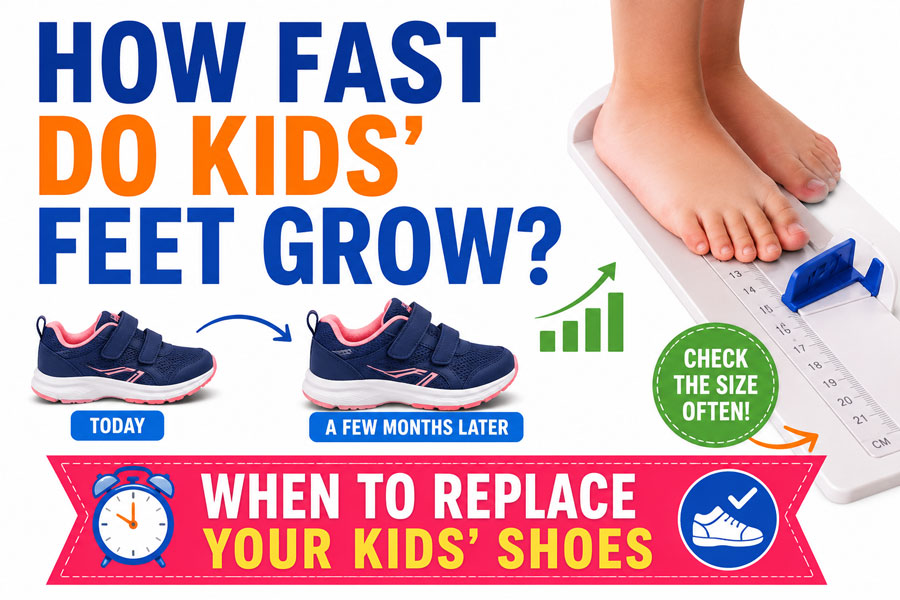
How Fast Do Kids’ Feet Grow? – A Guide by Age
Last updated: May 2026 | By Juan Valenzuela, Certified Children’s Shoe Fitter
One of the most common questions I get from parents at the store is: “How fast do kids’ feet grow?” It seems simple, but the answer surprises most families — and getting it wrong is one of the leading reasons children end up wearing shoes that are too small without their parents even realizing it.
As a certified children’s shoe fitter with over 10 years of experience, I have helped thousands of families understand their child’s foot growth and know exactly when it is time to replace their shoes. In this guide I will break it down by age, tell you what to watch for, and give you simple tools to check the fit at home.
Why Shoe Fit Matters More Than You Think
Shoes that are too small do not always cause obvious pain — especially in younger children who may not be able to articulate discomfort. Instead, they cause damage quietly: blisters, calluses, toe deformities, and postural issues can all develop from shoes that are consistently too tight.
I am always surprised when parents come into the store and tell me their child’s shoes lasted a whole year. In most cases, that tells me one of two things: the shoes were fitted too long to begin with, or the shoes are now too small and the child has just adapted to the discomfort.
On the other side, I hear from parents whose child outgrew their shoes in two months. That is also a sign something is off — most likely the shoes were fitted too short to start with.
The sweet spot is replacing your child’s shoes every three to six months depending on their age — with a proper fit check in between.
How Fast Do Kids’ Feet Grow? – Age-by-Age Guide
Every child grows at a different pace, so use these estimates as a general guideline rather than a fixed rule. Children grow in spurts, and it is completely normal for a child’s feet to stay the same size for several months and then jump two sizes in a short period.
Infants (0–12 Months)
During the first year of life, a baby’s foot grows approximately half a size every two months — making it the fastest growth rate of any stage of childhood.
At this stage, most infants do not need shoes. The priority is keeping feet warm and allowing toes to move freely. Rigid shoes at this age can actually interfere with healthy foot development. I recommend soft crochet booties that provide warmth without restricting natural movement.
When to check: Every 6 to 8 weeks.
Toddlers (1–3 Years)
Between ages one and three, a child’s foot typically grows a full shoe size every three to four months. This is one of the most critical periods for foot development — the arch begins to form, the foot starts taking its permanent shape, and the muscles and tendons are developing rapidly.
Shoes at this stage should offer a stable base of support while still allowing natural movement. Avoid stiff, rigid soles that prevent the foot from flexing naturally. I have a dedicated guide on the best shoes for toddlers if you need specific recommendations.
When to check: Every 6 to 8 weeks.
Preschoolers (3–5 Years)
Foot growth slows slightly during the preschool years. Expect a size increase approximately every four to five months. The structure of the foot becomes more defined during this period, and it is essential that shoes fit well to support healthy development.
This is also the age when I see many children start developing gait patterns — toe walking, intoeing, and flat feet often become more visible at this stage. If you notice anything unusual about the way your child walks, this is a good time to have it assessed by a pediatric physical therapist or podiatrist.
When to check: Every 2 to 3 months.
School-Age Children (5–12 Years)
As children enter school, foot growth continues steadily. On average, expect a size increase every five to six months, though growth spurts are common and can accelerate this significantly.
At this stage, supportive shoes become increasingly important. School-age children are active for long hours during the day — running, playing sports, and walking between classes — and poorly fitting shoes can cause cumulative damage over time. I recommend checking your child’s shoe fit at the start of each new school year and again around the new year.
When to check: Every 3 months.
Adolescents (12–18 Years)
Foot growth slows significantly during adolescence but does not stop completely. Teens can still experience growth spurts that affect their shoe size, particularly in early adolescence between ages 12 and 14.
Most girls’ feet stop growing around age 14. Most boys’ feet stop growing between ages 18 and 20 when the growth plates close. Keep in mind that even after feet stop growing in length, shoe sizes can still change — arches may flatten with age, feet can widen, and soft tissue changes can affect fit.
When to check: Every 3 to 4 months.
Quick Reference: Foot Growth by Age
| Age | Growth Rate | How Often to Check |
|---|---|---|
| 0–12 months | ~½ size every 2 months | Every 6–8 weeks |
| 1–3 years | ~1 size every 3–4 months | Every 6–8 weeks |
| 3–5 years | ~1 size every 4–5 months | Every 2–3 months |
| 5–12 years | ~1 size every 5–6 months | Every 3 months |
| 12–18 years | Slows significantly | Every 3–4 months |
How Much Growing Room Should You Leave?
Getting the right amount of growing room is one of the most important — and most misunderstood — parts of fitting children’s shoes.
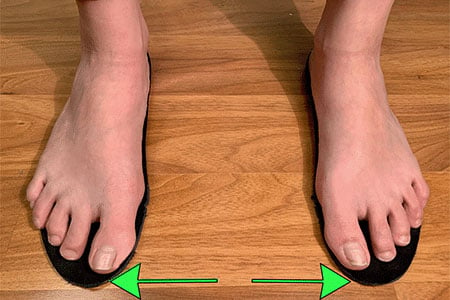
The rule I use at the store: there should be approximately 3/8 of an inch (about a thumb’s width) between your child’s longest toe and the front of the shoe. This allows for natural foot movement and provides enough room for the foot to grow without the shoe becoming a tripping hazard.
Too little room and the toes are compressed — this can cause blisters, calluses, and over time, toe deformities. Too much room and the shoe becomes unstable, increasing the risk of tripping and falls.
I have a dedicated guide that walks you through exactly how to check: How Much Growing Room Should Kids’ Shoes Have?
Signs Your Child Needs New Shoes
Do not wait until your child complains of pain — by then the shoe is already too small. Here are the signs I tell parents to watch for:
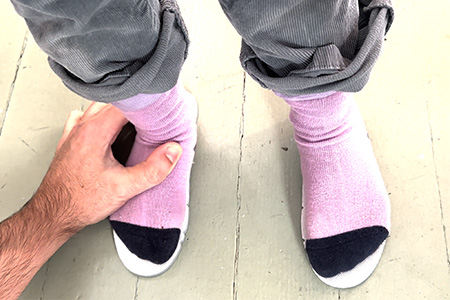
Toes touching the end of the shoe. Press gently on the front of the shoe while your child is standing. If you can feel their toes pressed against the end, it is time for a new pair.
Red marks or indentations on the feet. If you notice red marks on the tops of the toes or the sides of the foot after removing the shoes, the shoes are too narrow or too short.
Blisters or calluses. These develop from repetitive friction caused by shoes that are the wrong size or shape for your child’s foot.
Your child is walking differently. If your child has started walking on their toes, shuffling, or stumbling more than usual, check the shoe fit immediately.
The shoe looks worn down. Even if the shoe still fits in length, a shoe that has been worn for many months begins to lose its structural support — the heel counter softens, the cushioning compresses, and the outsole wears unevenly. At this point the shoe is no longer providing the support your child needs, even if it technically still fits.
When Should You Replace Shoes Even If They Still Fit?
This is something many parents overlook. A shoe can still fit in terms of length and yet need to be replaced because it has simply worn out. Here is what I look for:
- The heel counter feels soft and foldable when pressed
- The outsole shows significant wear, especially under the heel or ball of the foot
- The midsole has compressed and lost its cushioning
- The upper is breaking down or separating from the sole
A good rule of thumb: even if the size is still right, most children’s shoes should be replaced after 6 to 8 months of regular daily wear — sooner for very active children.
How to Measure Your Child’s Feet at Home
Knowing when to check the fit is only useful if you know how to check it correctly. I offer a free virtual shoe fitting service that walks you through how to measure your child’s exact foot length and width from home — so you can order online with confidence.
Learn How to Measure Your Child’s Foot Here
Need a Personalized Recommendation?
If you have questions about your child’s shoe size, foot shape, or when to replace their current shoes, reach out to me directly at customerservice@fittingchildrenshoes.com and I will be happy to help at no cost.
Frequently Asked Questions
Press gently on the front of the shoe while your child is standing. If you can feel their toes at the end, or if there is less than a thumb’s width of space, the shoe is too small. Red marks, blisters, and complaints of foot pain are also clear indicators.
Most girls’ feet stop growing around age 14. Most boys’ feet stop growing between ages 18 and 20 when the growth plates close. However, shoe sizes can still change after this due to arch changes, weight gain, and soft tissue changes that affect foot width.
It can be, but it is worth checking two things: first, that the shoes were not fitted too long to begin with; and second, that the current shoes still fit correctly. Children grow in spurts and may have a long plateau followed by a rapid jump. If you are concerned, have your child’s feet measured by a shoe fitter.
No. Shoes that are too big cause instability and increase the risk of tripping and falls. The correct amount of growing room is about a thumb’s width — roughly 3/8 of an inch — at the front of the shoe. Going more than that creates problems.
Have a question about your child’s shoe size or foot growth? Leave a comment below — I read and respond to every one.

Dear Juan,
Thank you for the very informative article! My problem in finding shoes for my daughter is a bit different than most people. She is 2yo and has very narrow feet and fallen arches (pronated feet); if they weren’t fallen in, she would have high arches. Can you recommend shoes that provide very good high arch support and correction to pronated feet, and which are what not too wide? Ideally you have ideas for tennis shoes, dress shoes and summer sandals that she could wear.
Thank you!
Hello Lino,
To recommend specific shoes for your daughter’s narrow feet and fallen arches I first need to know the country that you are contacting me to check what specific shoes you might be able to order.
My feet haven’t grown for 2-3 years and I’m a 16-year-old boy, is that normal or am I just build different?
Hello,
It’s totally normal. I have seen that some children’s feet don’t grow for a couple of years and they suddenly have a growth spurt.
I do get the point you are trying to make but I feel it’s a bit general. My daughter did have the same foot size for over a year and her shoes did last that length of time because she has a few pairs of shoes at any given time so they don’t wear down as quickly. She generally has leather School shoes/ soft indoor school shoes / sports trainers/ sandals / boots / party shoes / slippers all on the go at any given time.
Also her feet have gone up 4 sizes in the past 12 months – from a U.K. 11 to a UK 1 (she’s 8 years old) and I have her properly measured at a reputable shoe shop so I know it’s not me buying the wrong size to start with. I’m hoping the rapid growth of her feet are a sign she’s due a big growth spurt as she is very short for her age. Her feet are huge for her short height, but she’s always be a kid that’s ‘all feet’. Even as a toddler she had the biggest feet in the group whilst being the shortest.
Hello Linda,
You are correct, the estimates on foot growth I provide are just for a general guidance. The fact is that all children grow at a different pace, but I think it’s important for parents to have a general idea on when they should be checking their children’s shoes.
Your daughter wore the same shoe size for a year but that’s doesn’t normally happen among children. Maybe the shoes were fitted too long to begin with? Or she was due for a growth spurt… there could be many variables.
Good thing that you have a local children’s shoe store in the area that you trust so they can keep up with her growing feet!
Thank you for sharing!
I take my children to a good shoe store that properly measures feet and tells me the size they need to wear. I have taken my 5 year old to the shoe store every 3 months and she has not changed shoe size for a whole year. Today was the first time I had a hard time putting a pair of shoes on and I checked it and it just started getting to small. When she was younger I was getting different shoes every 2-3 months and yes even then she was getting properly measured. I also work for a podiatrist for the past 3 years so I also know and have seen that some kids feet and grow faster or slower than other kids just like their height. So your information is incorrect.
Hello Brandy,
You are correct, children’s feet do grow at different rates. The purpose of my article is to serve as a guideline for parents to have an idea how long they should be checking their kids’ shoes. However, you should not be replacing your daughter’s shoes once a year even if she hasn’t outgrow them. The shoes start wearing down and even if they don’t have holes on them they don’t provide the same support and they tend to stretch out around the heel area (this leads to the heel counter of the shoe getting softer).
There could be two reasons why you didn’t have to replace your daughter’s shoes for a whole year. The first might be that the shoes were fitted in the long side in the first place, and the second one that she was due for a growth spur. I am glad you are in good hands and have a children’s shoe store in your area that you trust. Thank you for sharing.
Hi Juan. Your site is very informative.
Your info about how quick their feet grows, I totally agree with what you are saying.
I haven’t been monitoring how long it takes for us to change the shoes of our children but I believe it is actually approximately a year. We either purchase because it is too small or because it has or is wearing out.
When we purchase the shoes, our children test them thoroughly and if comfortable we buy them. Not all shoes sizes are the same for every child for e.g. my youngest is 6 but looks 4. she wears shoes for 4/5 year olds because she is petit for her age. But all in all our shoes can last up to a year. There is a very small area of space left in the shoes for growth. At the same time it is not too big nor uncomfortable, loose, or tight. We make sure of that. So far we have had no issues with shoes and no incidents.
I more or less agree with all you have said. Thank you for the post. I have always wanted to know when the growth stops. I didn’t realize it can take up to 18 years!!!
Arif,
If your kids’ shoes are lasting you a whole year, something is not right. I believe you might be fitting them too long, since kids’ shoes don’t last for a whole year. They outgrow them way before that! Are you taking your kids’ to your local children’s shoe store to have someone measure their feet?
Mine lasted 4th through 7th and they looked nearly new when I finally outgrew at the start of 8th grade cross-country. I plan to buy my next pair of shoes 1.5 sizes large and expect them to last at least two years, and longer for casual use.
Thank you for sharing C. How old are you? As we get older our shoes start lasting us longer. I don’t recommend going a whole size and a half bigger since that might compromise your stability.
Children’s feet do grow fast, and knowing the methods to measure the feet over time will become helpful for the future. My parents are always complaining about my brother’s feet getting bigger every two months. Obviously they are doing something wrong. Is there a post you have on how to measure children’s feet properly? Maybe I can shoe it to my parents.
Thanks a lot dude
All the best
Lee
Lee,
Give this post a read: How to Measure Your Kids’ Foot – 2 Simple Steps to Determine Foot Length and Foot Width
Your parents will learn what steps to take in order to make sure your child is wearing the correct pair of shoes. If you have any other specific questions, please let me know.
This is awesome info! My wife always complained about how fast our children were growing and was always trying to leave extra room for them. But after I read your post, they weren’t growing so fast, they were growing at the rate they were supposed to!
Where can I find shoes for a child that plays soccer? Like wide soccer boots? Do they make them wide?
Hello Robert,Children feet do grow fast, we just need to keep a close eye on them and make sure they are not wearing shoes that are too tight! They do make soccer cleats in wide and extra wide widths for children. Is that what your child needs? I wrote a post where I describe the best wide soccer cleats for children. You can find the post here: Wide and Extra Wide Soccer Cleats for Kids
I just changed my child to a new pair of shoes this morning. Yesterday his grandmother saw his toes were red and asked me to check his shoes. I gave him this pair less than 2 months ago. And behold! They are already too tight for him.
Shoes are one of those things you can’t really buy wayyy in advance. I don’t have a particular shoe shop I frequent, so this is a problem every time I need new shoes for him. He’s turning 3 soon. I don’t keep track of how often he changes shoes.
Regina, A three year old should not have his shoes replaced every 2 months. I believe you are fitting his shoes too short or too narrow. It is hard to buy shoes when you don’t have a local kids’ shoe store in your area. Have you read my post on how to make sure your kids’ shoes fit? It will give you a set of guidelines to follow to make sure your child is wearing the correct shoe size: How Can I Make Sure My Kids’ Shoes Fit? – Learn The Secret Here!
Your website has a wealth of useful information, and as a parent of a 3-year-old, I’ve learned a lot from reading your posts. I actually have been replacing shoes much more sooner than what you state in your post, so I think your information here might be wrong. I find myself replacing my three year old shoes every 2 to 3 months,
Ayako,
You might be replacing your kids’ shoes every 2 to 3 months because you are not fitting the shoes properly. I believe you might be fitting the shoes too tight. Are you taking him to a children’s shoe store to have his feet properly measured?