
Best Basketball Socks for Kids: The Overlooked Piece of the Blister Puzzle
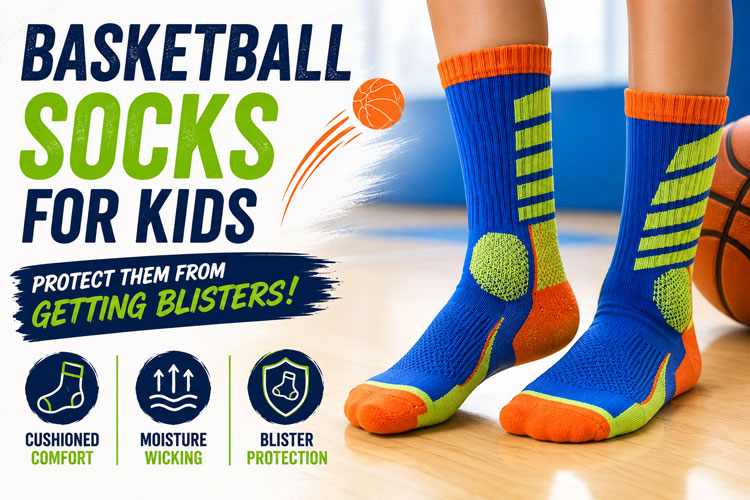
Parents spend a lot of time getting the shoe right — width, depth, toe box, the works — and then grab whatever socks are in the drawer. That’s a mistake. Basketball puts feet through more friction and sweat than almost any other kids’ sport, and the wrong sock can undo a perfectly good shoe fit. The right pair adds cushioning where it counts, keeps feet dry, and works with the shoe instead of against it.
Here’s what actually separates a basketball sock from a regular one, my picks for 2026, and how to get the sizing right.
What Makes a Basketball Sock Different From a Regular Sock
Targeted cushioning. Basketball socks pad the heel and the ball of the foot — the two spots that take the most repeated impact from jumping and landing. That extra padding absorbs shock and cuts down on the friction that causes blisters during quick starts and stops.
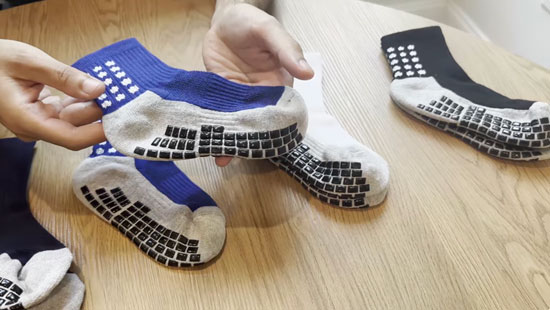
Moisture management. Kids’ feet sweat more during a fast-paced game than during almost any other activity, and a sock that traps that moisture instead of moving it away sets up the exact friction that leads to blisters — plus odor and fungal issues over time. Look for Dri-FIT or similar moisture-wicking synthetics rather than a sock that’s mostly cotton.
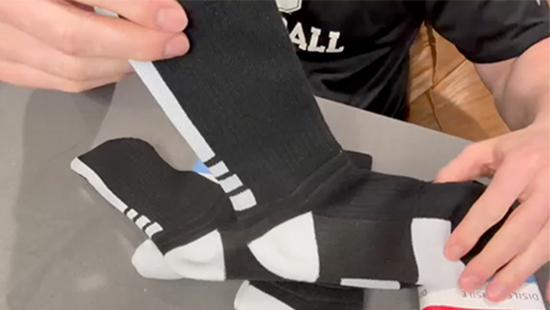
Best Basketball Socks for Kids for Extra Cushion and Support
I’ve tested each of these with kids on the court, not just read the spec sheet — these are the three that actually held up to a full season of sweat, sprinting, and hard stops without bunching, thinning out, or losing their cushioning.
Disclosure: this post contains affiliate links — I may earn a small commission at no extra cost to you if you make a purchase.
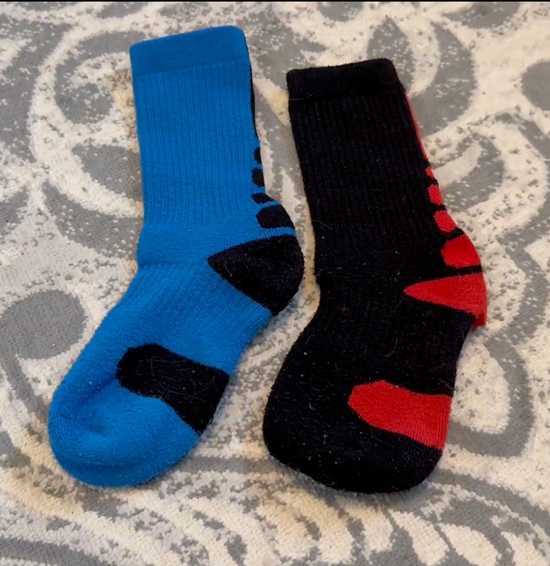
OLCHEE Basketball Socks. A cotton-blend sock with reinforced padding at the toe and heel — the two areas that see the most wear and impact during play.
- Order on Amazon
- 75% cotton, 15% polyester, and 10% spandex
- Reinforced toe and heel are
- Machine washable
MadSportsStuff Basketball Socks. A synthetic-heavy blend built for moisture control, with arch and ankle compression for extra in-game support.
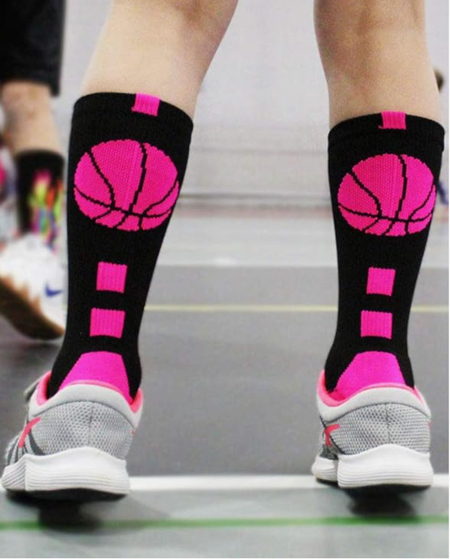
- Order on Amazon
- 77% Polypropylene, 17% Nylon, 3% Elastic, 3% Lycra Spandex
- Moisture wicking
- Arch and ankle compression
- Machine washable
JHM Basketball Socks. A thicker sock with cushioning strategically placed at the impact zones — a good option for kids who tend to blister easily.
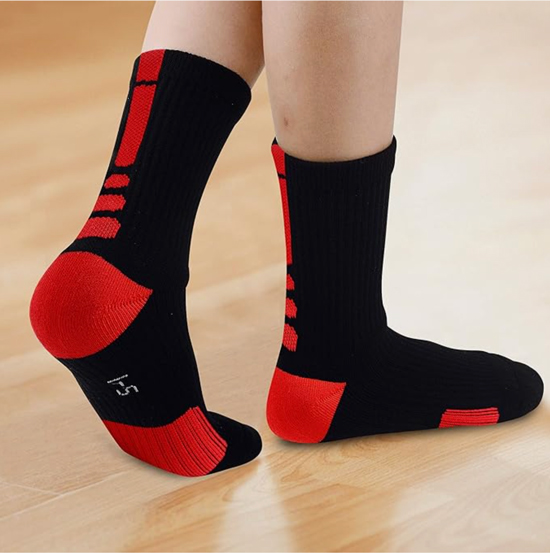
- Order on Amazon
- 80% cotton and 15% nylon
- Strategically placed cushions to target impact areas for increased comfort
- Breathable and thick enough to protect feet from impact
- Machine washable
How to Get the Sock Size Right
Sock sizing trips up more parents than you’d expect, mostly because of one label: sock packaging usually lists an age range or a generic “sock size,” and neither maps cleanly to your child’s actual foot. Ignore both of those and check the shoe-size range printed on the tag instead — that’s the number that actually corresponds to your child’s foot length.
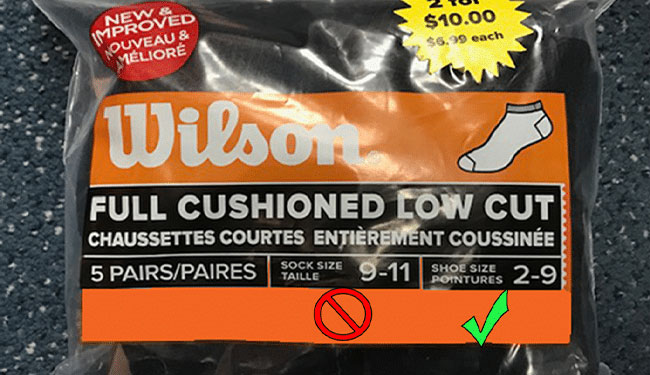
Getting it wrong in either direction causes problems: too tight restricts blood flow and can be uncomfortable over a long game, while too loose lets extra fabric bunch up inside the shoe — which is its own blister risk, regardless of how good the shoe or sock is on its own.
Cotton vs. Synthetic: Why Material Matters More Than You’d Think
It’s tempting to assume a sock is a sock, but material is where basketball socks earn their keep. Look for polyester or nylon-based blends with genuine moisture-wicking properties — they pull sweat away from the skin and keep their shape through a full game without stretching out or bunching.
Cotton, despite its reputation as a “natural” and comfortable choice, actually works against you here: it absorbs sweat rather than moving it away, which keeps the foot damp and increases friction — the exact combination that leads to blisters. A sock that’s mostly cotton is fine for everyday wear, but it’s not the right choice for the court.
Pair the Right Socks With the Right Shoes
Socks and shoes work as a system, not separately. If your child’s basketball shoes are borderline in fit, the wrong sock can push them from “a little snug” to genuinely uncomfortable — and the reverse is true too. When you’re shoe shopping, bring the actual socks your child will wear to games so the fit you’re testing is the real one. If you haven’t settled on shoes yet, my basketball shoe recommendations are a good place to start.

I ordered a bunch of pairs of the socks you recommend and they have work wonders for my child! He doesn’t complain about his feet feeling too hot or wet. I am so happy! He always tell me those are the best socks he has ever had! Thank you Juan!
I am glad he is happy! Socks can make all the difference when wearing shoes. Make sure he is wearing the right type f shoe and he is all set to go! Let me know if you have any other questions!
My child has struggled with this for years and I resorted on putting multiple pairs of socks on my child’s foot to try and help the problem. I like the fact that you use evidence to back up your claims and to support your statements. After purchasing the socks you recommend, my child feet stay dry and the blisters had disappeared! You are awesome! Thank you!!
Spencer,
It’s all about making children happy! Now he only needs to worry about playing ball! Keep wearing the socks with good supportive shoes so the blisters don’t come back!
Hello there,
Have you ever heard of bamboo fabric socks for sweaty sports?
Bamboo has antibacterial properties and I think this may be beneficial for sports socks.
Great tips for looking for the right kind of socks, and I think a lot of the support and padding features would be great across all sports socks.
Thanks for the tips!
Kris
Kris,
I have not heard of bamboo socks for sports yet, and I usually only review and write about products that I have either worn myself or products that we sell in the store and I am familiar about their quality. They do seem to be a great idea since they have antibacterial properties. Thank you for sharing.
Wow I had no idea! I thought all socks were the same; it just depended on personal choice of comfort. Oops 😉 thanks for the information! You really know your stuff! Just one thing, have you tried these out? I know it’s about children mostly, but just wondering since you seem to have the knowledge 🙂
Kristen,
Not all socks are the same just like not all shoes are the same! I haven’t tried these out, but at the kids shoe store I work for we sell them and the children love them! I only recommend shoes or socks that I have either worn or fitted before! You can’t go wrong with these socks!
Love the info! My son has such problems with socks! They are always bothering him and his feet tend to sweat a lot.You have mentioned that cotton socks absorb the sweat rather wicking it away. I always thought cotton socks were the best, are they suitable for normal wear? Where can I purchase the socks that you recommend?
Hello! Are you getting your son the right size sock? A sock that is too long will bother me as well! Cotton socks do absorb the sweat instead of wicking it away. There is a misconception about cotton socks. You can defintiely wear them as your daily socks.For years I also thought they were the best material I could possible find. However, you are better socks with socks made out of synthetics such as CoolMax and Dri-Fit, since they will keep your child feet cool and dry! The socks I recommend are sold on Amazon and Zappos.