Best Kids’ Shoes for Supination – Prevent Foot Pain and Improve Posture
By Juan Valenzuela | Certified Children’s Shoe Fitter with 10+ Years of Experience
If your child has been diagnosed with supination — or you’ve noticed their feet rolling outward when they walk — the right footwear can make a significant difference. Supination is less common than pronation, but it’s equally important to address early. This guide explains what supination is, how to spot it, what to look for in a shoe, and which specific styles work best for children with this condition.
What Is Supination?
Supination (also called underpronation) is the opposite of pronation. Instead of the foot rolling inward during walking, a supinating foot rolls outward — placing most of the body’s weight along the outer edges of the foot.
In a neutral gait, weight is distributed evenly across the entire foot from heel strike to toe-off. When a child supinates, that balance is lost. The outer edge bears the load it wasn’t designed to carry, which over time creates stress up the entire kinetic chain — ankles, knees, hips, and lower back.
Supination is most commonly associated with high arches. A high arch is rigid and doesn’t absorb shock the way a normal or low arch does, which is why children with this condition often complain of tired, achy feet — especially after prolonged activity.
How to Tell If Your Child Is Supinating
You don’t need a specialist to spot the early signs. Here are two simple checks any parent can do at home:
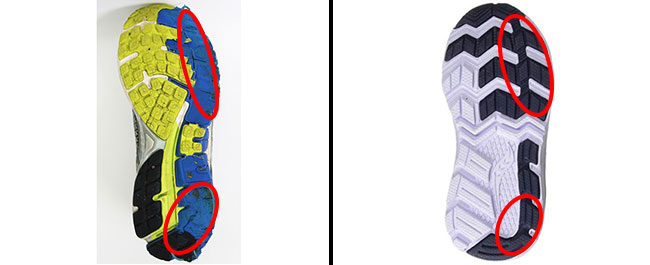
Check the shoe soles. Pick up a pair of your child’s everyday shoes and flip them over. If the outer edges show noticeably more wear than the inner edges or the center, your child is likely supinating. Uneven wear on the outside of the heel and forefoot is the classic pattern.
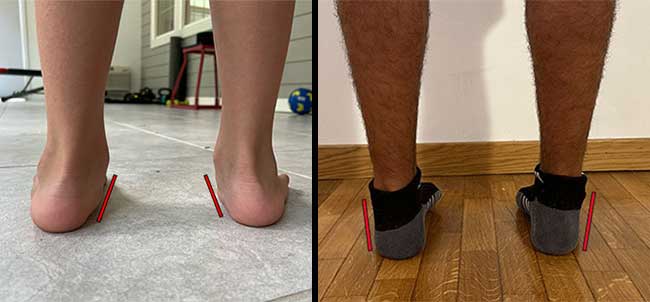
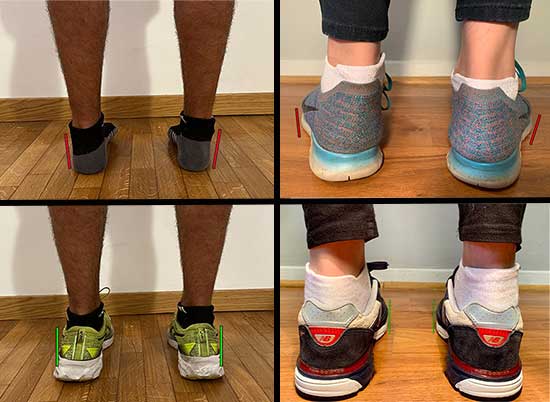
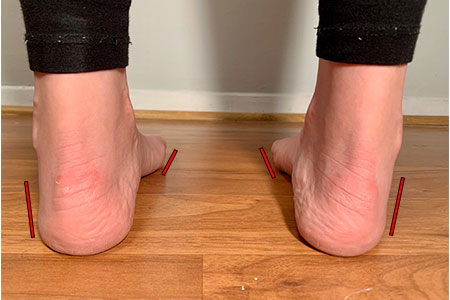
Watch them stand barefoot. Have your child stand naturally on a hard floor and look at their feet from behind. If the ankles tilt outward and the arches appear very high with little contact in the midfoot area, that’s a strong visual indicator of supination.

If you’ve observed either of these signs, it’s worth having your child evaluated by a pediatrician or physical therapist — particularly if they’re also reporting foot pain, leg fatigue, or frequent ankle sprains.
What Supination Can Cause If Left Unaddressed
The outward rolling of the foot puts strain on structures that aren’t built to absorb it. Without proper support, children with supination are at higher risk of developing:
- Calluses and foot rigidity from repeated pressure on the outer edge
- Hammer toes or claw toes from abnormal weight distribution
- Chronic ankle sprains due to lateral instability
- Plantar fasciitis from excessive tension on the plantar fascia
- Knee, hip, and lower back pain from compensatory gait patterns
The encouraging news is that children’s feet are still developing, and the right footwear — introduced early enough — can meaningfully correct the way they bear weight and move.
Before and After: What Supportive Shoes Actually Do
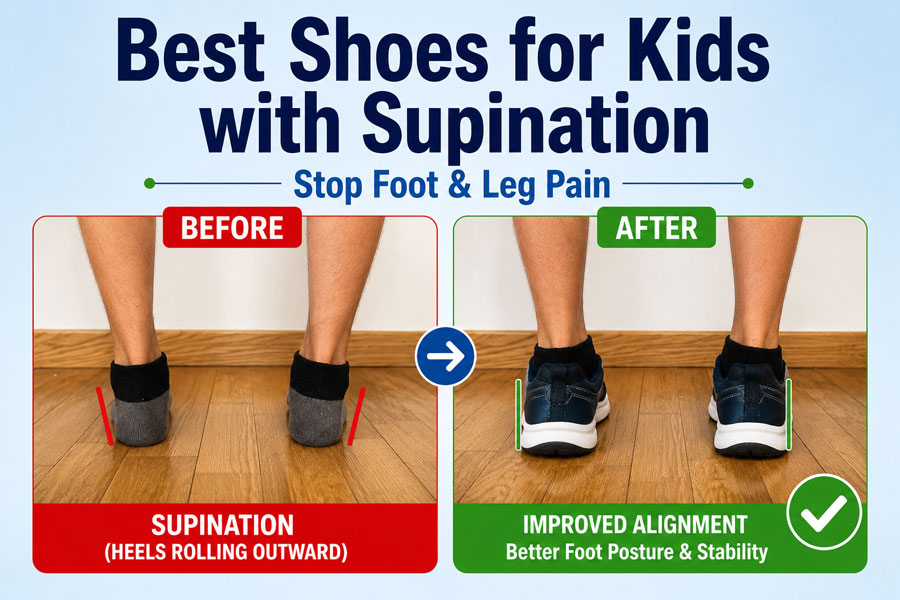
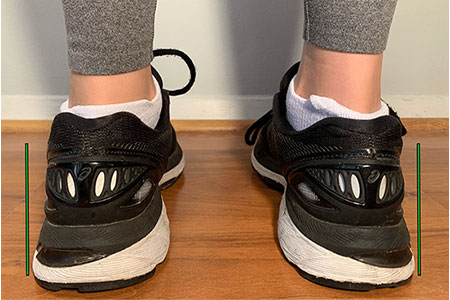
The visual difference between a child standing barefoot with supination and the same child in supportive shoes is often striking. Barefoot, you’ll see the weight shifting heavily to the outer foot, the ankles tilting outward, and the high arch creating an obvious gap between the midfoot and the floor.
In a well-fitted supportive shoe, the foot sits more centered, the ankle is held upright, and the cushioning absorbs the shock that the rigid arch cannot.
What to Look for in a Shoe for Supination
Supination requires a different shoe strategy than pronation. Where pronation calls for motion control and a straight last, supination calls for cushioning, flexibility, and neutral or slightly curved lasts that allow the foot to move naturally without forcing it further outward.
The three most important features to look for are:
1. Deep, cushioned midsole. Because a high arch absorbs almost no shock on its own, the shoe needs to do that work instead. A thick, well-cushioned midsole — particularly in the heel and forefoot — dramatically reduces the impact stress on the outer foot.
2. Neutral or slight curve last. A shoe built on a neutral last doesn’t overcorrect in either direction. It simply allows the foot to function more naturally. Avoid rigid motion-control shoes designed for pronation — these push the foot further outward and make supination worse.
3. Flexible outsole. A flexible outsole allows the foot to move through a natural range of motion. A too-stiff outsole locks the foot in place and amplifies the outward rolling pattern. The shoe should flex easily at the ball of the foot.
The Best Kids’ Shoes for Supination
Every shoe below has been selected based on hands-on fitting experience with children who have supination and high arches. They are available in a range of widths — check the notes under each style. Disclosure: This post contains affiliate links, and we may earn a small commission at no extra cost to you.
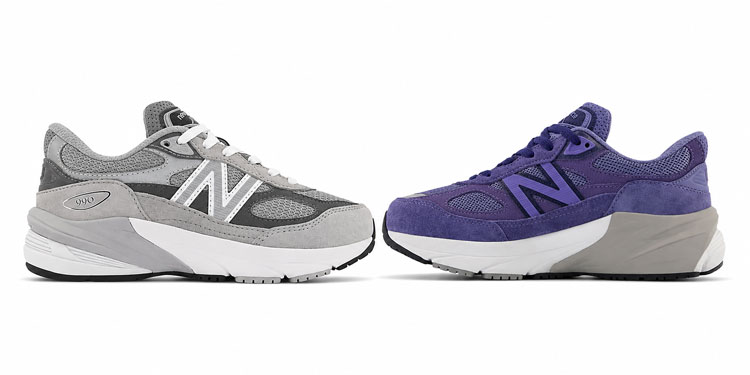
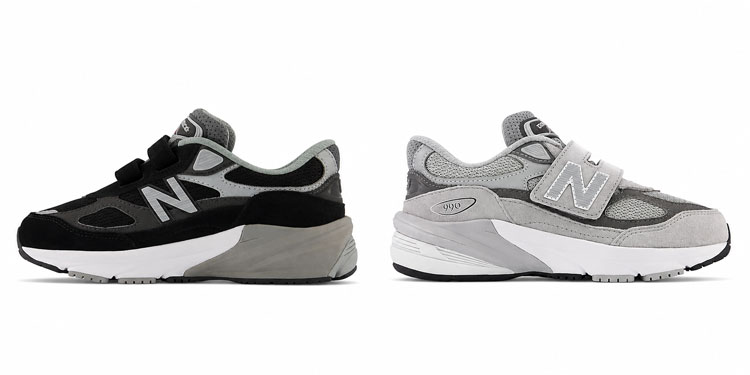
1. Shoe Style 990v6 by New Balance
Best for: Toddlers through big kids | Supination and high arches | Medium, Wide, and Extra Wide feet
The 990v6 is the most consistently effective shoe I recommend for children with foot alignment issues, including supination. Its midsole provides exceptional cushioning depth, the heel counter keeps the foot centered without over-correcting, and the construction is substantial enough to handle the lateral stress of supination without breaking down quickly.
The price is the most common objection from parents, and it’s fair — this is not a budget shoe. But the durability and results justify the investment for children with significant supination.
Key Features
- Available for toddlers, little, and big kids
- Order with laces on the New Balance website or Amazon
- Velcro version also available on the New Balance website or Amazon
- Accommodates medium, wide, or extra wide feet
- Firm heel counters, stable base of support, and semi-straight lasts
- Ideal for moderate to strong cases of pronation
- Removable insoles
- Sizing tip: Order a half size larger than your child’s current foot size
2. Shoe Style Gabi and Alvin by Memo (Orthopedic Shoe)
Best for: Toddlers and little kids | Moderate to significant supination | Medium and wide feet
The Memo Gabi is a medically designed orthopedic shoe built for children whose foot conditions haven’t responded adequately to standard athletic footwear. The reinforced structure, double velcro closure, and deep footbed provide a level of corrective support that most mainstream shoes simply can’t match.
It’s a more clinical-looking shoe than the others on this list, and it comes at a premium price — but for children who genuinely need orthopedic-level intervention, it delivers.
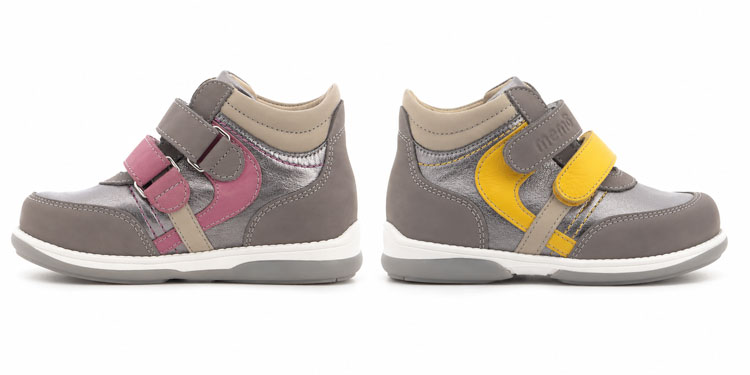
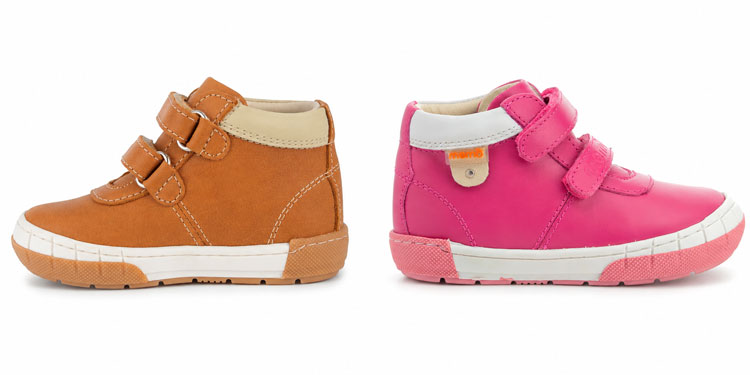
Key Features
- Available for toddlers and little kids
- Order the model Gabi or Alvin on Amazon
- Also available in a Mary Jane style and a version for older kids called Memo Polo
- Accommodates medium and wide feet
- Ideal for moderate to strong cases of pronation
- High-top design with stiff heel counters
- Sizing tip: Order a half size larger than your child’s current foot size. Refer to Memo sizing chart
3. Shoe Style Elliott by Stride Rite
Best for: Toddlers only | Supination and high arches | Medium, Wide, and Extra Wide feet
For toddlers, ankle stability is just as important as arch support — young children’s ankles are still developing and particularly susceptible to the lateral instability that supination creates. The Elliott’s high-top design addresses this directly, wrapping the ankle and providing support that a low-cut shoe can’t offer.
It’s affordable, easy to get on and off, and provides far more structural support than a typical toddler sneaker.

Key Features
- Available for toddlers
- Order on Amazon
- Accommodates medium, wide, or extra wide feet
- Ideal for mild to moderate cases of pronation
- 100% leather construction
- High-top design provides extra ankle support
- APMA Seal of Acceptance
- Sizing tip: Order a whole size larger than your child’s current foot size
4. Shoe style 574 by New Balance
Best for: Toddlers through big kids | Mild to moderate supination | Medium, Wide, and Extra Wide feet
The 574 is a solid everyday option that balances support and affordability well. Its cushioned midsole handles the shock absorption that high-arched feet need, and it’s available in a wider range of widths than most shoes at this price point. It’s not as corrective as the 990v6, but for children with milder supination it performs very well.
Available in lace and Velcro versions.
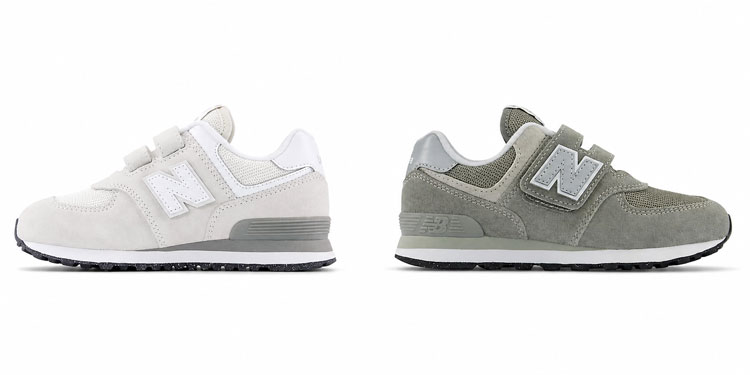
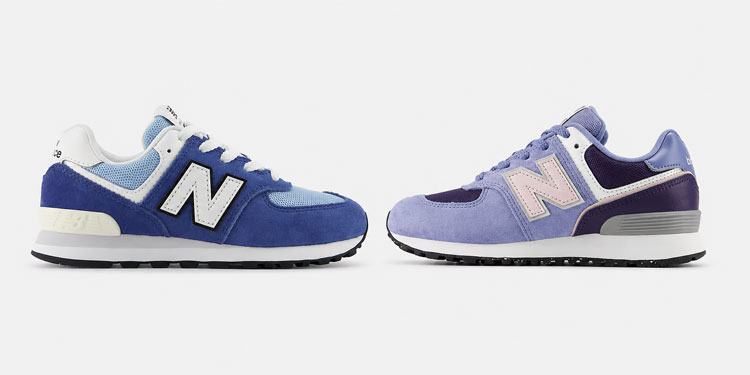
Key Features
- Available for toddlers, little, and big kids
- Order on Amazon or the New Balance website
- Also available with laces on the New Balance website or Amazon
- Accommodates medium, wide, or extra wide feet
- Ideal for mild to moderate cases of pronation
- Firm heel counters
- APMA Seal of Acceptance
- Sizing tip: Order a half size larger than your child’s current foot size
5. Shoe Style Tracks by Timberland
Best for: Toddlers and little kids | Supination | Medium and wide feet
The Tracks is built for rugged use — it’s water-friendly, high-topped, and structurally robust. If your child spends significant time outdoors, on uneven terrain, or in wet conditions, this is the most practical pick on the list. The ankle support is particularly valuable for children with supination, who are prone to lateral ankle sprains on unpredictable surfaces.
It’s heavier than the other options here, which can be a factor for younger or smaller children.

Key Features
- Available for toddlers and little kids
- Order on Amazon
- Accommodates medium or wide feet
- Ideal for mild to moderate cases of pronation
- High-top design for extra ankle support
- Water-friendly construction
- Sizing tip: Order a whole size larger than your child’s current foot size
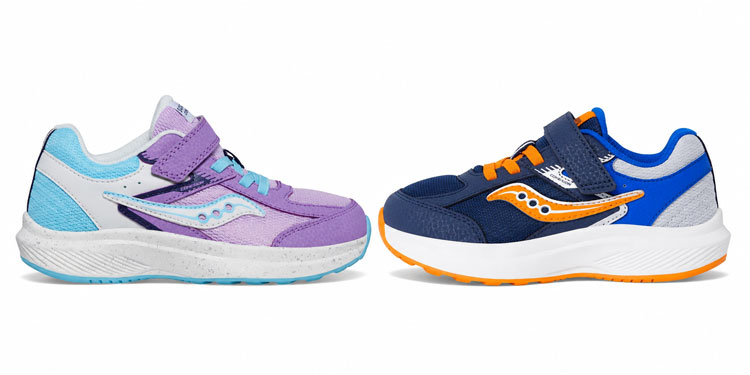
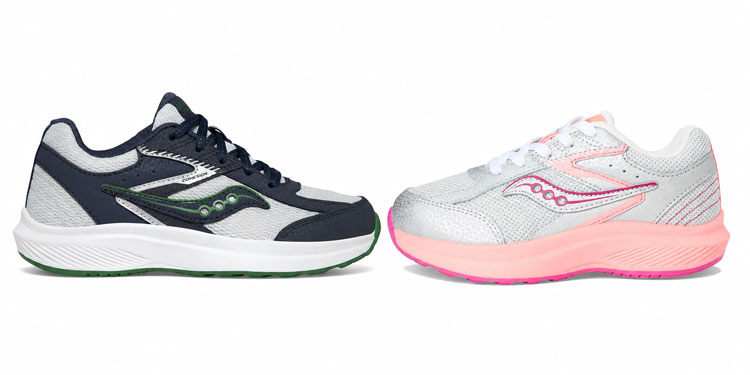
6. Shoe Style Cohesion by Saucony
Best for: Little and big kids | Mild to moderate supination | Medium and wide feet
The Cohesion is the most accessible shoe on this list price-wise, and it earns its place. The cushioned midsole does a competent job absorbing lateral impact, and the heel counter provides reasonable stability. For families managing tight budgets or for a secondary pair of shoes, this is an excellent choice.
Key Features
- Available for little and big kids
- Order on Amazon
- Also available with laces on Amazon
- Accommodates medium or wide feet
- Ideal for mild to moderate cases of pronation
- Firm heel counters and stable base of support
- Sizing tip: Order a whole size larger than your child’s current foot size
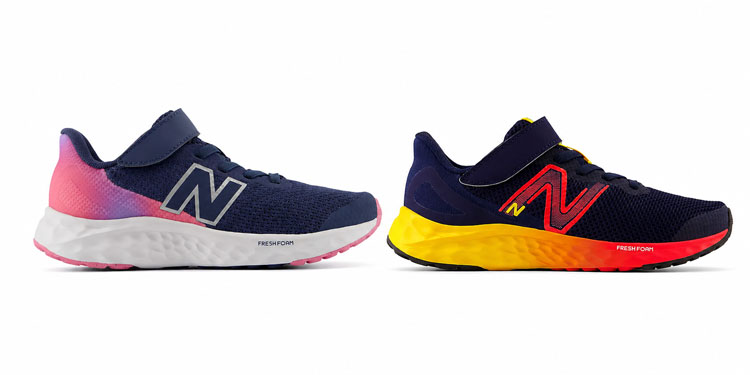
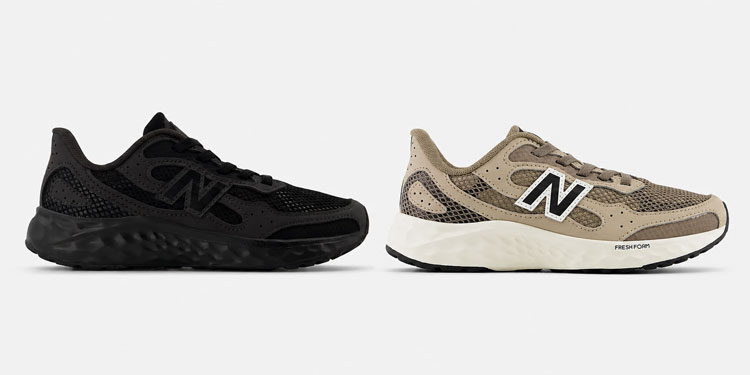
7. Shoe Style Fresh Foam Arishi v4 by New Balance
Best for: Toddlers through big kids | Mild to moderate supination | Medium, Wide, and Extra Wide feet
Some children with sensory sensitivities resist wearing structured shoes because the firmness feels uncomfortable. The Arishi v4 uses New Balance’s Fresh Foam cushioning to deliver a noticeably softer underfoot feel while still maintaining enough structure to support the foot. It’s the best choice when compliance is an issue — a shoe the child will actually wear consistently beats a better shoe they refuse to put on.
Key Features
- Available for toddlers, little, and big kids
- Order on the New Balance website or Amazon
- Also available with laces on Amazon or the New Balance website
- Accommodates medium, wide, or extra wide feet
- Ideal for mild to moderate cases of pronation
- Semi-firm heel counters
- Sizing tip: Order a whole size larger than your child’s current foot size
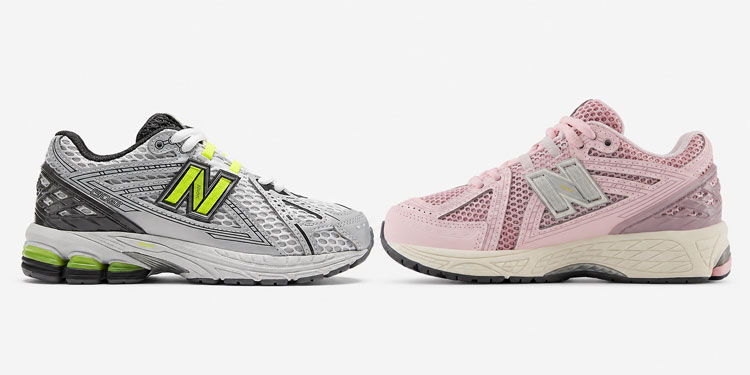
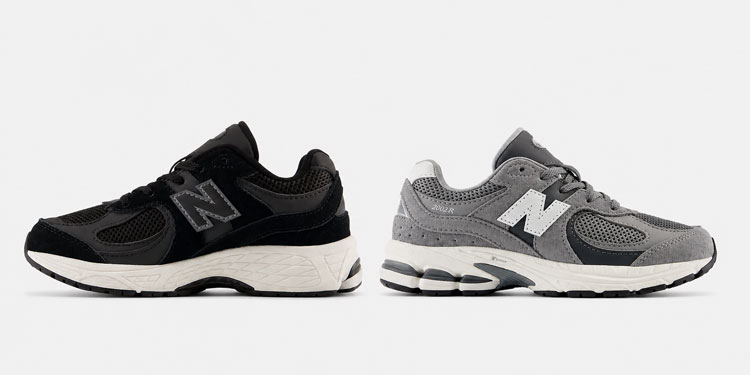
8. 002/1906 by New Balance
Best for: Toddlers through big kids | Moderate supination | Medium and wide feet
The 2002 sits in the middle of the New Balance lineup — more supportive than the Arishi, less expensive than the 990v6. It’s a dependable all-round choice for families who want New Balance quality at a more moderate price point.
Key Features
- Available for toddlers, little, and big kids
- Order the 2002 or 1906 on the New Balance website
- Accommodates medium or wide feet
- Ideal for moderate to strong cases of pronation
- Firm heel counters, stable base of support, and semi-straight lasts
- Sizing tip: Order a whole size larger than your child’s current foot size
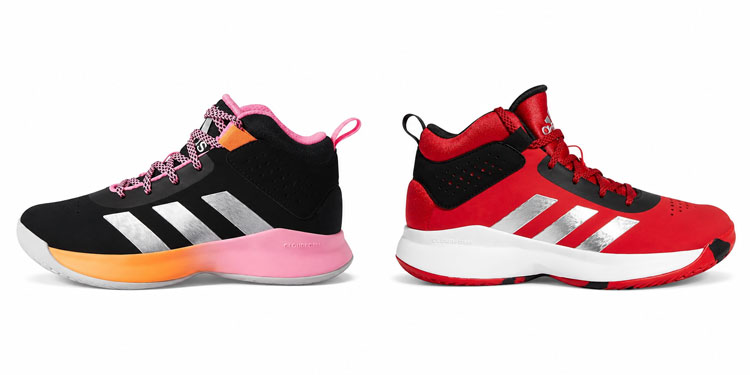
9. Shoe Style Cross Em Up by Adidas
Best for: Little and big kids | Supination | Medium and wide feet
This basketball-inspired high-top offers excellent lateral support, which is particularly valuable for children with supination who are active in sports. High-tops naturally brace the ankle against outward rolling, and the firm midsole handles impact well during dynamic movement. A strong choice for kids involved in court sports or who are generally very active.
Key Features
- Available for little and big kids
- Order on Amazon
- Accommodates medium or wide feet
- Ideal for mild to moderate cases of pronation
- High-top design for additional ankle support
- Versatile — suitable for sports and everyday wear
- Sizing tip: Order a whole size larger than your child’s current foot size
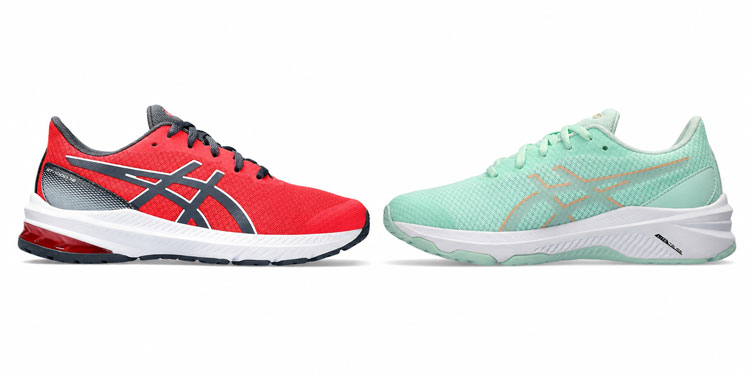
10. Shoe Style GT-1000 by Asics
Best for: Little and big kids | Moderate supination | Narrow and medium feet
Most supportive shoes run wide, which is a problem for children with narrow feet. The GT-1000 is one of the few stability shoes that fits a narrower profile naturally, while still providing the cushioning and structured support that supination requires. If your child has a slim foot and high arches, this is the shoe to try first.
Key Features
- Available for little and big kids
- Order on Amazon
- Accommodates narrow or medium feet
- Ideal for mild to moderate cases of pronation
- Firm heel counters, stable base of support, and semi-straight lasts
- Sizing tip: Order a whole size larger than your child’s current foot size
A Note on Laces vs. Velcro
Laced shoes offer a superior fit for children with supination. The ability to tighten the lacing across the midfoot and around the ankle means the foot is held more securely in place, reducing the lateral sliding that makes supination worse. Velcro shoes are a practical necessity for younger children who can’t yet tie laces — but as soon as your child is able, transitioning to laced shoes is worth doing.
Does My Child Also Need Orthotics?
Possibly, but it’s not always the first step. I generally recommend starting with a supportive shoe and monitoring your child’s progress over two to three months. Many children see meaningful improvement with footwear alone.
If pain persists, or if a physical therapist or pediatrician has already identified the supination as significant, orthotics are a reasonable next step. They can be custom-made through a specialist or purchased as over-the-counter insoles — both have their place depending on the severity of the condition.
One important note: orthotics only work when paired with a structurally supportive shoe. Placing an orthotic inside a thin, flexible sneaker won’t give you the results you’re looking for. The shoe needs to be able to hold the orthotic in place and provide the surrounding structure for it to function correctly.
Getting the Right Fit
Fit matters as much as shoe selection. A well-chosen shoe in the wrong size won’t provide the support your child needs. Learn How to Measure Your Child’s Foot Here
Start Now — Don’t Wait
Supination doesn’t resolve on its own. The earlier it’s addressed, the better the outcome. Children’s feet are most responsive to correction during the early years, but even older children benefit significantly from proper footwear — improved gait, reduced pain, and better posture are achievable at any age with the right shoes.
If you have questions about your child’s specific foot shape or degree of supination, feel free to reach out at customerservice@fittingchildrenshoes.com. Every child’s feet are different, and a personalized recommendation makes a real difference.
Juan Valenzuela is a certified children’s shoe fitter with over 10 years of experience specializing in fitting shoes for children with supination, high arches, flat feet, and related foot conditions.