
Best Shoes for Kids with Sensory Issues – Seam-Free, Soft, and Built for Comfort
Last updated: August 2026 | By Juan Valenzuela, Certified Children’s Shoe Fitter
Struggling to find shoes your child will actually wear? You’re not alone — this is one of the most common (and most emotionally exhausting) challenges I help families with. Kids with sensory sensitivities aren’t being difficult on purpose. What looks like a meltdown over “nothing” is often a very real, very physical reaction to a seam, a stiff collar, or a shoe that just doesn’t sit right on their foot. In this guide, I’ll walk you through exactly what to look for, share the shoes I recommend most often in fittings, and help you figure out whether your child needs a looser or snugger fit.
Key Features: Soft Materials and Seam-Free Fabrics
Your child’s shoes need to feel just right — or they simply won’t wear them. For kids with sensory sensitivities, even the slightest discomfort can turn shoes into a daily battle. Finding the right pair can feel overwhelming, but the right shoes can make a real difference in your child’s comfort and your own peace of mind.
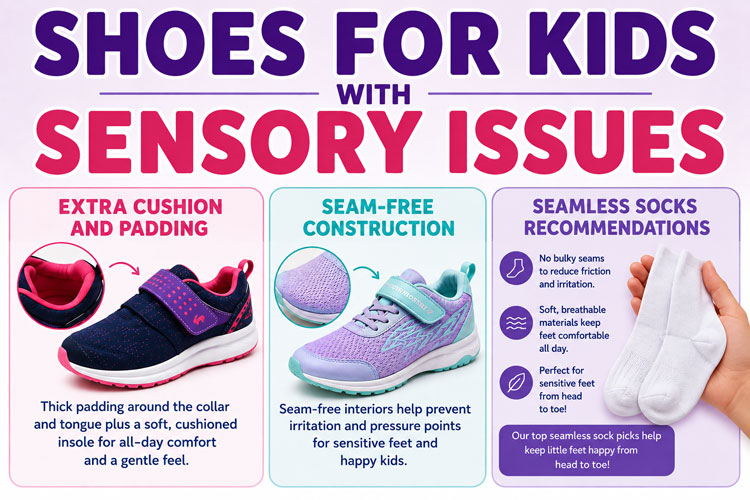
Extra Cushion and Padding: Extra cushion and padding help absorb impact, reduce stress on the feet, and create a gentler, more supportive environment — all of which can ease some of the discomfort tied to sensory sensitivities.
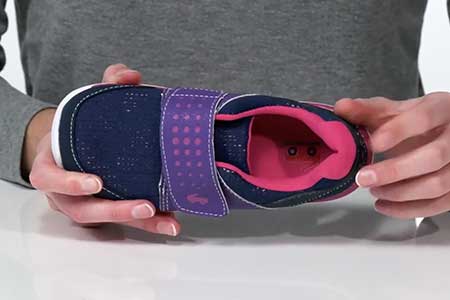
Seam-Free Construction: Seam-free construction is a genuine game-changer. Traditional seams rub and irritate, which can lead to discomfort and even blisters. A smooth, seam-free interior removes those pressure points entirely, giving your child one less thing to fight against.
Does Your Child Prefer Tighter or Looser-Fitting Shoes?
In my experience, children with sensory issues almost always fall into one of two camps — some want their shoes loose, others want them snug. If your child often says shoes feel “too tight,” look for styles with extra depth and a rounded toe box. If they complain that shoes feel “too loose,” look for a narrower platform, a supportive heel counter, or multiple points of adjustability (like laces or a BOA dial). Certain lacing techniques can also help create a more secure, customized fit that gently hugs your child’s foot.

Sensory-Friendly Shoes: A Patient Path to the Right Fit
Patience and empathy matter more than anything else here. After fitting shoes for hundreds of children with sensory challenges, I can tell you — what looks like resistance or fussiness is usually your child’s honest way of expressing real discomfort. They’re not being difficult. They’re overwhelmed by how something feels, and they don’t always have the words for it yet.
A soft, seam-free shoe made from premium leather is a great place to start. Look for styles with wide-opening tongues, which make shoes easier to slip on without pressing on your child’s foot. Before you try shoes at all, it can help to “desensitize” your child’s feet with a gentle massage — warming the feet up tends to make the whole process go more smoothly.
Best Shoes for Kids with Sensory Issues – Seam-Free Interiors
Based on my years of fitting experience and feedback from the families who’ve tried these shoes, here are my top recommendations for 2026. Disclosure: This post contains affiliate links. We may earn a small commission (at no extra cost to you) if you make a purchase through them.
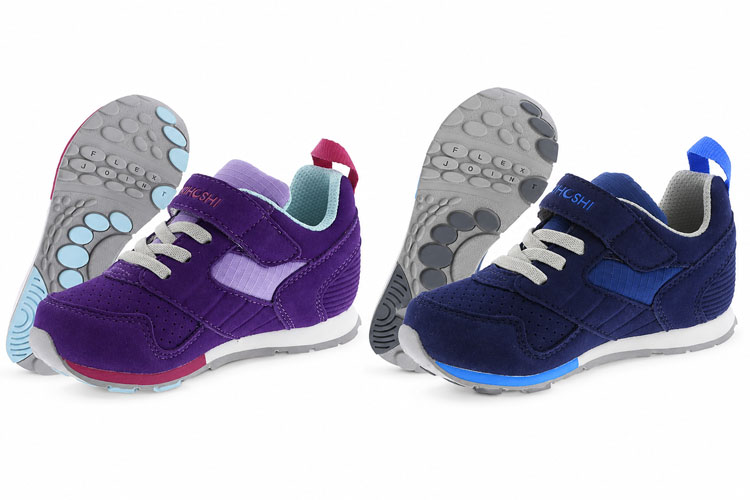
Racer by Tsukihoshi
These Tsukihoshi toddler shoes are lightweight, flexible, and machine-washable, ideal for active toddlers with medium to wide feet.
Key Features
- Order on Amazon
- All Tsukihoshi shoes fit wider than traditional medium-width shoes
- Rounded edges to decrease stumbles and falls
- Ideal for kids who like their shoes on the “looser” side
- Order the same size as your child’s current foot size — this shoe fits long
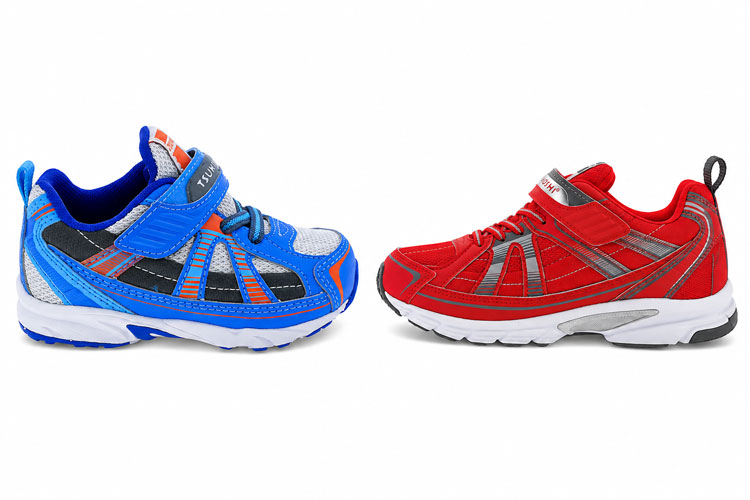
Storm by Tsukihoshi
These Tsukihoshi sneakers are lightweight, breathable, and provide a stable base of support for everyday activities.
Key Features
- Order on Amazon
- All Tsukihoshi shoes fit wider than traditional medium-width shoes
- Ideal for kids who like their shoes on the “looser” side
- Lightweight, flexible design with a stable base of support
- Generous toe-box allows toes to splay naturally for better balance and comfort
- Breathable mesh upper helps keep feet cool and comfortable
- Machine-washable upper for easy cleaning
- Order the same size as your child’s current foot size — this shoe fits long
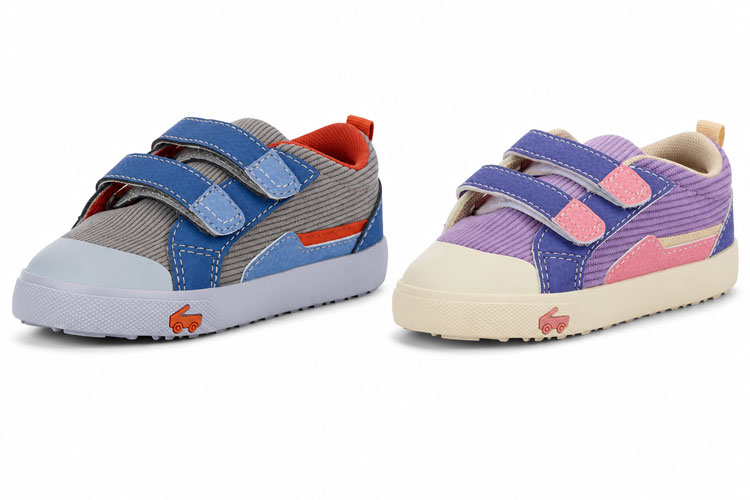
See Kai Run Riley
See Kai Run makes some of the best naturally wide shoes for toddlers and young children. The Russell (boys) and Robyne (girls) are not available in a labeled wide width — but they are cut wide enough to accommodate most children with wide feet without needing to size up in width. Physical therapists regularly recommend this brand.
Key Features
- Order on Amazon
- Available for toddlers and little kids
- Fits medium and wide feet
- Ideal for kids who like their shoes on the “looser” side
- APMA Seal of Acceptance
- Padded tongue and collar
- Breathable textile lining and cushioned insole
- Order one full size larger than your child’s current foot size
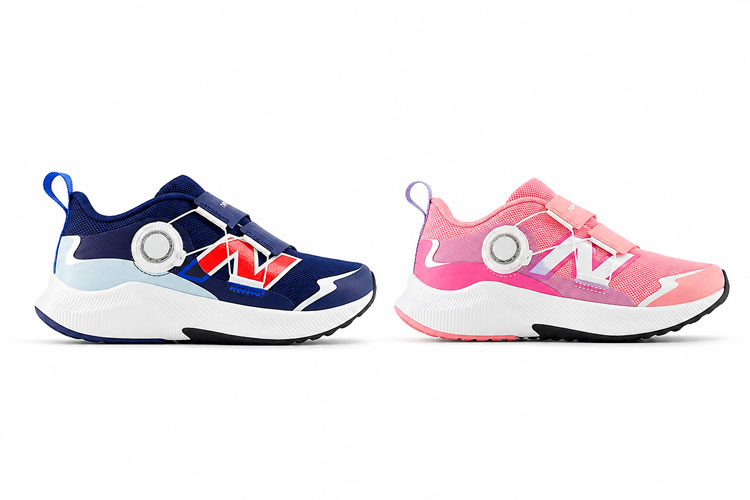
Dynasoft Reveal v4 by New Balance
A no-sew mesh upper means a smooth, irritation-free interior, while the plush DynaSoft midsole delivers soft, responsive cushioning. The BOA® Fit System allows for quick, precise, lace-free adjustments.
Key Features
- Order on the New Balance website or Amazon
- Available in medium and wide widths
- Ideal for kids who like their shoes on the “tighter” side
- BOA® Performance Fit System for a locked-in fit
- No-sew overlays for durability in the toe and heel where kids need it most
- Order a half size larger than your child’s current foot size
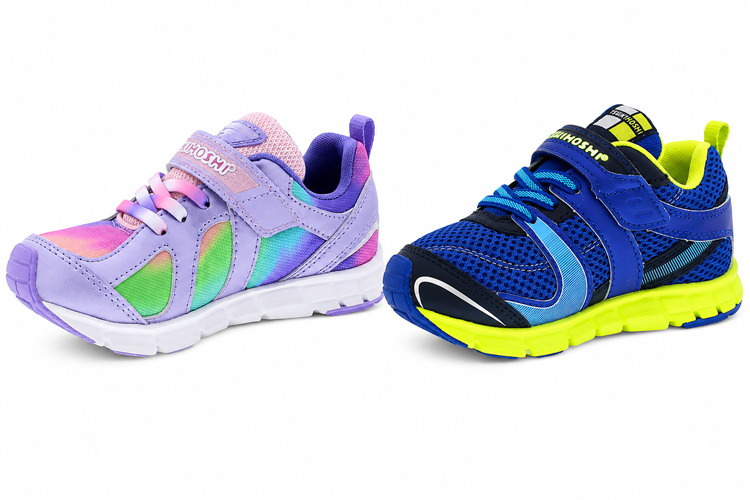
Velocity and Rainbow by Tsukihoshi
These sensory-friendly Tsukihoshi shoes for orthotics feature a lightweight, flexible sole and a wide toe box to avoid pressure points. The seamless, breathable interior and soft materials help reduce irritation.
Key Features
- Order the Velocity or the Rainbow model on Amazon
- Fits medium and wide feet
- Ideal for kids who like their shoes on the “looser” side
- Hook and loop closure system for easy on and off
- Long heel counter for added stability
- The insoles are infused with natural Green Tea extract (no chemicals)
- Machine washable
- Order the same size as your child’s current foot size — this shoe fits long
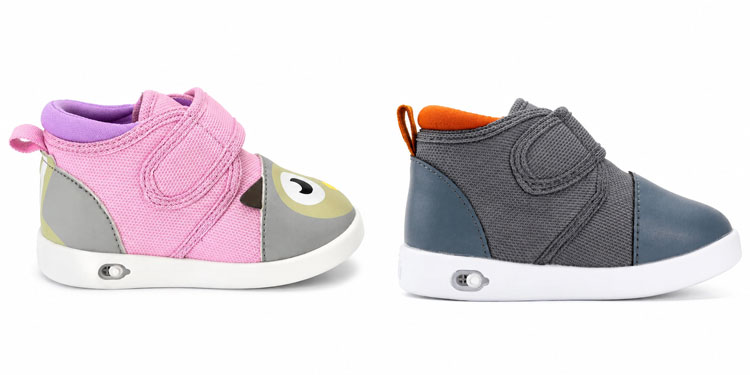
IKIKI
Soft, flexible materials, a wide opening, and a single-strap closure make these easy to put on and adjust. The roomy fit minimizes pressure points, and the seam-free interior reduces irritation.
Key Features
- Order on Amazon
- Not available in wide or extra wide widths but fits naturally wide
- Ideal for kids who like their shoes on the “looser” side
- Wide opening makes it easy to put on and take off
- Synthetic vegan leather
- Squeaks can be turned on/off with a switch
- Order a whole size larger than your child’s current foot size
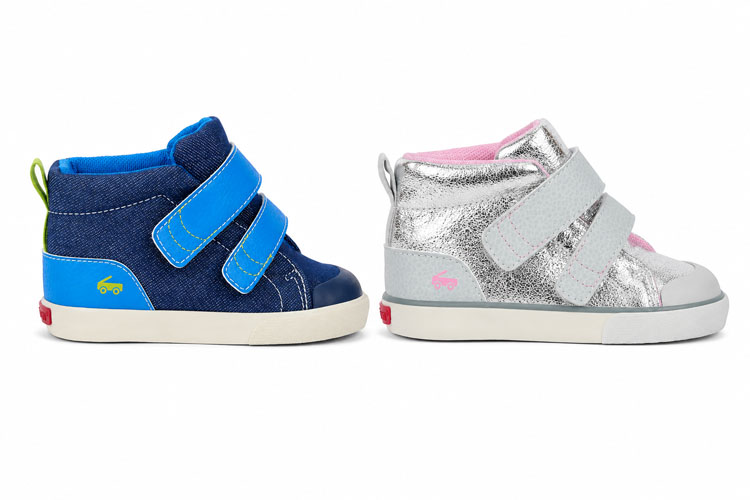
Dean Adapt II by See Kai Run
Wide, seam-free interiors and a flexible sole that moves naturally with the foot. The extra-padded heel collar and easy on/off design suit kids who need comfort without pressure points.
Key Features
- Order on Amazon
- Ideal for kids who like their shoes on the “looser” side
- Not available in wide or extra wide widths but fits naturally wide
- Soft, flexible mesh upper, fully lined with minimal seams
- Order a half size larger than your child’s current foot size
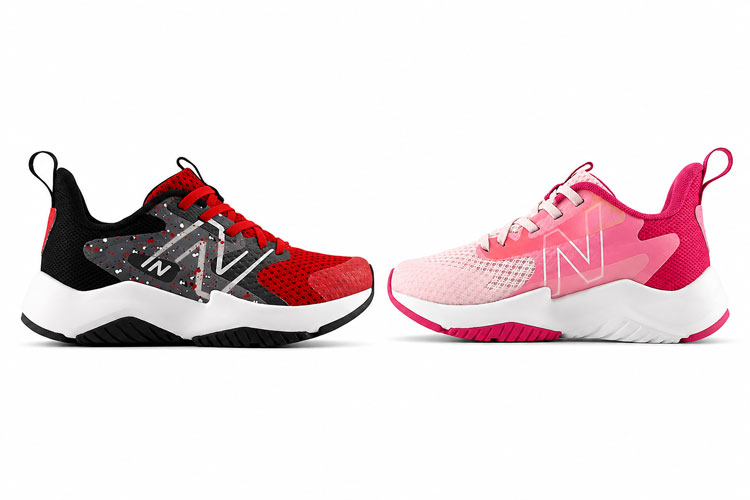
Rave Run v2 by New Balance
An affordable, extra-wide-friendly option from New Balance available in little kid and big kid sizes. The no-sew construction gives it a sleek fit and feel — no rough overlays or stitching to irritate sensitive skin — while the breathable mesh upper and extra depth keep feet cool and comfortable during active play.
Key Features
- Order the Velcro version on the New Balance website or Amazon
- Order the Lace-up version on the New Balance website or Amazon
- Accommodates medium, wide, or extra wide feet
- Works for kids who like their shoes looser or tighter, as laces allow maximum adjustability
- Breathable mesh upper
- No-sew construction for a smooth, irritation-free interior
- Padded collar and tongue for extra comfort
- Sizing tip: Order a half size larger than your child’s current foot size
Contact Me for Personalized Recommendations
Every child is unique, and sometimes off-the-shelf advice isn’t enough. If you’re struggling to find the right pair for your child, feel free to email me for a personalized recommendation. My goal is to help every child find footwear that fits well and supports their individual sensory and developmental needs.
Read This Before Ordering Your Child’s Shoes Online
Getting the right size is the single most important step to ensuring comfort for a child with sensory sensitivities — an improper fit can heighten discomfort and even lead to foot issues over time. I created a virtual shoe fitting service to help you accurately measure your child’s feet from home. It reveals whether your child has narrow, medium, wide, or extra wide feet — and identifies a high instep, which is key to finding a comfortable fit.
What Are the Best Socks for Kids with Sensory Issues?
Before your child even tries on shoes, make sure they’re wearing the right socks — the socks change how the shoe feels far more than most parents expect. Look for soft, breathable materials with a snug (not tight) fit. I’ve found seamless socks are close to a requirement for kids with sensory issues, and the fabric should feel soft against the skin without constricting toe movement.
For my full sock recommendations and what to look for, check out Best Socks for Kids with Sensory Issues.
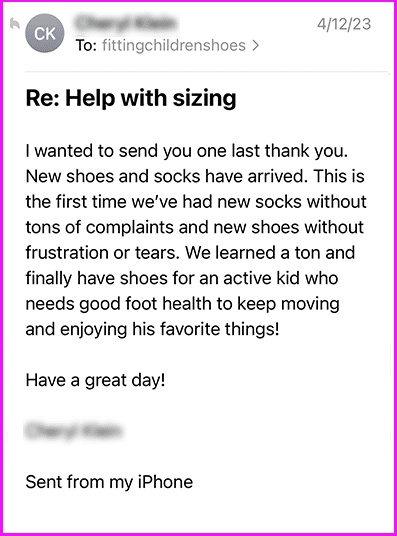
Feedback From Families
Real-world feedback matters. Families who’ve tried the shoes I recommend often report meaningful improvements in their child’s comfort and willingness to wear shoes.
Does Your Child Need a Pair of Seasonal Shoes?
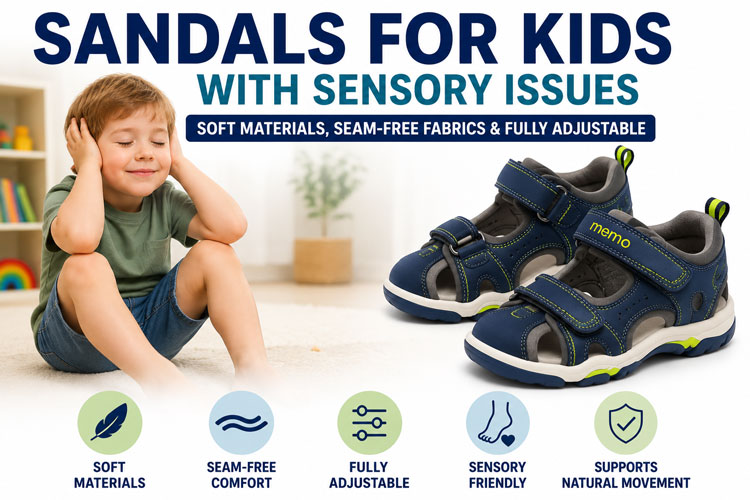
For warm weather, sandals with adjustable straps, cushioned soles, and seam-free fabrics can offer the comfort your child needs, with ample toe protection and a secure fit. During colder months, winter boots with soft linings and flexible soles are a better bet — just make sure they’re easy to put on and take off, since complex fastenings can be their own sensory hurdle.
Don’t get discouraged if your child says every pair of shoes feels “too tight” — you’re not alone, and the right fit is out there. Instead of sizing up (which can throw off balance and stability), try a wider width first. In my experience, this solves the issue about 90% of the time without sacrificing support.
If you’re visiting a local kids’ shoe store, let the fitter know upfront that your child has sensory sensitivities. That heads-up helps them slow down and create a more patient, thoughtful fitting experience.
Frequently Asked Questions
A sensory-friendly shoe has a seam-free interior, soft and flexible materials (like premium leather or knit mesh), a wide opening for easy on/off, and enough depth in the toe box to avoid pressure points. The best option also matches your child’s specific preference for a tighter or looser fit.
Usually not. In most cases the real issue is width, not length. Sizing up compromises stability and can actually make discomfort worse. Try a wider width in the same length first — it resolves the “too tight” complaint the vast majority of the time.
For most kids with sensory sensitivities, yes. Even a soft, well-fitted shoe can feel wrong over a sock with a bulky toe seam. Pairing sensory-friendly shoes with seamless socks removes one more variable that can trigger discomfort.
A gentle foot massage beforehand can help “desensitize” sensitive feet. Keep shoe-shopping trips short, offer two options at a time rather than overwhelming choices, and let your child walk around in the shoes for a few minutes before deciding.

I have an 11 year old who needs a pair of hiking boots or shoes for an outdoor program at school. She currently wears a 2.5 and is very sensitive to both tight toe boxes and loose heels. We have spent a lot of money on shoes over the years because she’ll try a pair on, *think* they are good, and only after she’s worn them out and about a few times (and they can no longer be returned) will she discover something about them that bothers her. True hiking boots preferred but anything with good traction, good support, and water resistance will do.
Hello Amy,
Take a look at my recommendations below:
Option 1 Make sure to select the wide width.
Option 2 I selected the shoe size 2 1/2 wide.
I suggest that you apply this shoe lacing technique to secure your daughter’s heels inside the shoes: How to Lace Kids’ Shoes to Prevent Heel Slippage – 3 Easy and Simple Steps!
Let me know if you have any there questions.
Skechers (wide) seem to work for our son who has sensory issues with his feet.
Our current issue is soccer shin guards. He doesn’t like to wear them inside and that’s what the soccer league prefers. He won’t even try the sleeve because you have to add them in addition to socks (another issue). Have you found a solution (perhaps 1 sock that has a sleeve built in)? The soccer socks are an entire other issue, would love to hear any recommendations. He loves soccer, but the stress of getting ready is difficult for the entire family.
Thank you for sharing all your supportive information here!
Hello Kris,
Thank you for your feedback about the Skechers working well for your son!
I am sorry to hear about the shin guard issue. Unfortunately, I don’t have a solution to this. I know some families have their children wear two pairs of socks, they just put a pair of socks on first, then the shin guards, and then another pair of socks. I am not sure how well this will work for your son as he dislikes the feeling of soccer socks.
With that said, I hope other families who read this will provide us with feedback as they might have found a solution already.
Please help us! My daughter has to wear shoes this year for in person school- told safety reasons for gym and fire drills etc. She Is 6 and wore her winter bogs into summer months until we found her a pair of bogs rainboots that are now too small but insists on wearing as none of her other shoes feel right. We have every seamless sock available and what works one day doesn’t always work the next. We know that she has SPD and ADHD and have been trying the brushing and compression before going trying shoes. We have now exhausted all of the brands at kiddie kobbler that are recommended for kids with spd, sketchers, off the rack shoes, tried used so not stiff. Her feet measure 12.5 on left and 13 on right and the fitter said her feet aren’t wide but her toes are squared off on the ends so she prefers wider fit shoes and ones that don’t touch the top of her toes or pinch them. She used to prefer Mary Jane style shoes and ugg boots and last year wore stride rite velcro strap sandals. We have spent countless hours in shoe stores ( only short trips each time so not too overwhelmed) and even brought home a few pair that felt good in store but now refuses to wear because they aren’t comfortable to her.I want to help her find ones that feel good to her so she can go to school and be able to run and play with other kids.
She wants to go to school and I know she is trying so hard to not just kick off every shoe she tries on. Sometimes she gives us feedback like where it feels tight to her, other times ” JUST FEELS WEIRD”. She used to wear crocks but this summer they were “too bumpy and weird”. Even winter bogs aren’t working for her now. At home she goes barefoot inside and in front and back yard..even made sensory pathway with different textures to help with sensitivities.
Feeling helpless and hopeless though I keep reassuring her we will find the right ones for her just sometimes takes a while to find them.
Hello Lisa,
I am happy to help.
From your daughter’s feedback it seems like she wants her shoes to feel on the “looser side”.
Are you contacting me from Canada? The reason I ask is that the shoe store you mentioned is located in Canada. I need to know from which country you are contacting me to check what specific shoes are available in your area.
Does the school your daughter attends requires the shoes to be made of specific color?
Please help us! My daughter has to wear shoes this year for in person school- told safety reasons for gym and fire drills etc. She Is 6 and wore her winter bogs into summer months until we found her a pair of bogs rainboots that are now too small but insists on wearing as none of her other shoes feel right. We have every seamless sock available and what works one day doesn’t always work the next. We know that she has SPD and ADHD and have been trying the brushing and compression before going trying shoes. We have now exhausted all of the brands at kiddie kobbler that are recommended for kids with spd, sketchers, off the rack shoes, tried used so not stiff. Her feet measure 12.5 on left and 13 on right and the fitter said her feet aren’t wide but her toes are squared off on the ends so she prefers wider fit shoes and ones that don’t touch the top of her toes or pinch them. She used to prefer Mary Jane style shoes and ugg boots and last year wore stride rite velcro strap sandals. We have spent countless hours in shoe stores ( only short trips each time so not too overwhelmed) and even brought home a few pair that felt good in store but now refuses to wear because they aren’t comfortable to her.I want to help her find ones that feel good to her so she can go to school and be able to run and play with other kids.
She wants to go to school and I know she is trying so hard to not just kick off every shoe she tries on. Sometimes she gives us feedback like where it feels tight to her, other times ” JUST FEELS WEIRD”. She used to wear crocks but this summer they were “too bumpy and weird”. Even winter bogs aren’t working for her now. Feeling helpless and hopeless. At home she goes barefoot inside and in front and back yard..even made sensory pathway with different textures to help with sensitivities.
Feeling helpless and hopeless though I keep reassuring her we will find the right ones for her just sometimes takes a while to find them.
Hello,
My daughter can not tolerate socks ( seamless, low cut , soft material any sensory kind) and shoes together. She will wear shoes without socks. What tips I can use?
Thanks,
Hello Krupal,
Have you tried a pair of SmartKnit Socks?
Tsukihoshi shoes have worked really well for several children with sensory issues. I think a good place to start is by retrieving your daughter’s exact foot length and shape, to make sure that she is wearing shoes in the correct size: How to Measure Your Kids’ Foot – 2 Simple Steps to Determine Foot Length and Foot Width
Is there a way to get slightly larger sizes. My 10 year old is Autistic and he’s outgrown all the local shops that sell velcro shoes. I can’t get him to wear anything. He’s a size 7.5 and your largest size is a 7. I wish I new about these shoes when he was younger, could’ve stopped a lot of issues we’ve had.
Hello Crystal,
Most velcro shoes stop at a shoe size 7, but I am happy to help you find a pair of shoes for your son. However, I first need to know whether your son’s feet are medium, wide, or extra wide. If you are unsure of your son’s foot shape you can follow the instructions here: How to Measure Your Kids’ Foot – 2 Simple Steps to Determine Foot Length and Foot Width
MY son doesn’t seem to like any snowboots. Any recommendations?
Hi Kristi,
How about trying an insulated and waterproof hiking boot? There are certain boots that might feel softer for his feet. Take a look at my recommendations below:
Option 1
Option 2
I hope this helps.
My son is extremely difficult to buy shoes for. He complains that some shoes are rubbing his heels, and other shoes have a seam or something near the toe. So far he’s only able to wear the sandals made for boys that have the velcro on the top of the foot and in the back. He pulls the velcro on both sides so tight they no longer connect with the rest of the velcro on the shoe so I have to add fabric velcro from the sewing section of the store. This velcro never holds so we end up fighting the shoes on a daily basis because the velcro straps keep popping up. Any ideas for a child that has to have the shoe tightened on the back and the front?
Hello Tracy,
There is a particular sandal style that can be adjusted in 3 different places, which will give your son more control over how tight or loose he wants the sandal to feel.
Adjustable Sandal: Option 1
Adjustable Sandal: Option 2
These sandals also come with a soft padding around the heels, which will help your son feel more comfortable.
I hope this helps!
I love all the information you have provided. My seven year old just picked out a new pair of shoes at the store and once again has removed the insoles! I don’t understand why he does this every time or if this ok to allow or if the shoes are wrong? And if so, what shoes to get?
Hi Jessica,
I have seen other children do this as well. Have you asked your child why he keeps removing the sole of the shoes? I need to know whether he feels that the shoes feel too tight or too loose, and then I can provide you with specific shoe recommendations. It’s important that your child wears his shoes with the insoles, since they provide extra cushion and support to your kids’ feet.
Let’s see if you can find out why your boy keeps doing this, and once you do, we will discuss how to proceed.
My son is almost to the point that he will not wear shoes due to his sensory issues. He says that all shoes and socks are too loose no matter how tight they are. We recently tried the New Balance Boa system shoes and they are the tightest fitting shoes that I have found. He hates seamless socks and will not wear them and prefers thick “tight” socks. I guess every kid with sensory issues is different. I’m hoping he will not stop wearing his new NB Boa system shoes after a couple of weeks like he has with the last 5 pairs of shoes. Any advice?
Hello Daniel,
I am sorry your son is going trough this and I think you are right, every child with sensory issues is a little different. If he likes his socks and shoes really tight, I recommend trying a pair of tighter, compression-like socks (spandex/lycra like materials).
As far as the shoes go, have you tried shoes that come with shoelaces? This might help giving your son more control on how tight he wants the shoes to feel.
If he likes tighter fitting shoes you should try the shoe brand named Saucony. These two shoe styles to be more specific:
Saucony for kids with Sensory Issues: Option 1
I hope this helps!
My son has sensory issues. He is always complaining that his feet are hot. If we would let him wear sandals during the winter, he would. He is flat footed, with wide feet. Do you have a suggestion for a shoe?
Hello Brenda,
Can you please provide me with your son’s foot length and also tell me whether he prefers Velcro or shoelaces.
Thank you.
My 6 year old son struggles with this stress on a daily basis. Unfortunately the problem is not with the actual shoes or socks. I buy only seamless socks. Even those I have to turn inside out. That seems to help a little. He can wear the same pair of shoes every day but some days they bother him more than others. Especially in the morning before school. I’ll definitely try massaging his feet in the morning. Hope this will help??
Thank you for sharing Darlene! I believe that the shoes and socks do play an important role because children won’t tolerate any type of shoes and socks.Massaging the feet will make an important difference as well since this will help desensitize the feet and will make him less sensitive to the touch.
He wears about a size 6 youth. Thanks for your help.
Hello Amber,
These are the shoe styles that I recommend:
Option 1
Option 2
Both of these shoe styles run long, so don’t leave as much growing room. I will suggest getting your child a shoe size 6 or a 5 1/2.
I hope this helps!
I’m so exhausted from finding a pair of shoes for my son. He’s 11 so he’s in big kid shoes. Therefore, certain options aren’t even available to him because he’s older. The ONLY thing he will wear is Bogs boots or crocs. It’s weird, he normally wants everything as tight as possible, if he finds a shoe we can get him to put on he has to tie it so dang tight and multiple times. But yet he prefers the loose croc. Recently he broke his foot in PE class because he was wearing crocs. He now needs an actual shoe for school. I just dread finding one. The last time we tried he tried on 10+ pairs, ended up picking one and then 2 weeks later he refused to wear them. Please help with brands that may work for him.
Hello Amber,
From what you told me, your child used to like his shoes extremely tight but now it seems that he likes them to be looser. What is his shoe size?
There is a particular shoe brand named Tsukihoshi that gives that “loose feel”, and the shoes are very soft and comfortable. Once you send your child’s shoe size I can send you specific recommendations.
I am at my wits end with trying to find shoes for my 6 year old daughter. We must have tried 20 pairs over the past 2 weeks and there were plenty of shoes that fit her but they just didn’t feel right. It is causing me so much stress. I don’t know what to do as she has no shoes to wear. She is a D width so very narrow but hates them being tight on the side or the top but also hates them being loose around the heel. Help. I have tried Clarks, Startrite, every trainer I can think of, pumps, M&S, Next, Skechers. She just cannot cope with the feel of shoes. It is such a stress for me and I know she cannot help it but at the end of the day she needs to wear shoes.
Hello Hannah,
Sorry to hear that since I know how frustrating that can be.
Have you tried the New Balance or Saucony styles I recommend? These styles tend to be very soft and cushiony.
Did you try a pair of sneakers with shoelaces for her? This can take care of allowing some extra room for her toes to freely move inside the shoe without having too much extra space around her ankles. They key is also to try to distract her while is trying the shoes on so she doesn’t think too much about it. If you go try shoes for her and nothing feels right just try another day and start fresh. Try putting two different shoe styles on her feet and ask her which ones feels better.If you are sure you are getting the correct shoe style and shoe size for her then it will be a matter of her getting used to. I hope this helps!
Do you have any recommendations for summer shoes? We live in the mountains in Colorado. We have snow boots, but she doesn’t usually need something so burly. She LOVES sweater boots, but she tears them apart in minutes
Dear Nicole.
Are you looking for a dressy sandal or a water play sandal?
well, my question was confusing! I meant winter shoes – not summer shoes! Our girl puts on sneakers and is instantly mad at the world, but we need something that will keep her foot warm and dry. She’d love to live in flip flops, but that’s just not possible here!
Hello Nicole,
Do you know her foot width? There are a couple of nice hiking waterproof boots that are the most comfortable ones and they tend to fit a medium foot width to a wide foot.You can find them below (the first two choices I have fitted before and I know how great they are in terms of comfort and quality).
The Best Hiking Boots for Kids with Wide Feet – Waterproof, Lightweight, and Supportive!
My son has sensory issues with his toe. Everything is too tight, pinches and he is wearing shoes that are two sizes too big for him but the shoe only lasts a few weeks then it is an issue again. One of our biggest struggles is cleats. He is also a baseball player and we can’t find cleats that he will wear without a ton of tears and yelling. He loves baseball and it is boarder line him giving it up just so he isn’t tormented because he has to wear cleats.
Andrea,
Does your son has wide or extra wide feet? I know he is having a hard time dealing with the shoes, but providing him with a shoe that is two sizes too long will only compromise his stability and make him more prone to falling down. I want you to try a wider shoe instead of a longer one. When it comes to baseball cleats, I do have something in mind that might work. There is one baseball cleat that is available in wide widths, or you can even use the soccer one for baseball. You can find them in this post:
Wide Width Baseball Cleats – They Do Exist!
Please let me know if this helps!
Oh! Also…any recommendations on a sensory friendly shoe for big kids that Velcro?
Thanks!
Yes, the one I recommend in the post below are very soft, flexible, and lightweight and at the same time they are available in different widths such as medium, wide, and extra wide.
Velcro Kids Sneakers In Large Sizes – Finding Velcro Shoes For Kids WIth Big Feet!
First of all thank you so much for these articles. My daughter has SPD among other issues and the sock and shoe sensitivity has taken on a life of its own lately. We’re to the point that she’s missing school and not leaving the house only because she can not tolerate the feeling of the socks and shoes. Do you have any suggestions for a narrow heel? She’s got my goofy feet that have an extremely high instep/arch and then a narrow heel. We’ll get a new pair of shoes on her and she’ll say they feel ok, but then as soon as she stands and walks she flips out and rips them off saying her heel is slipping. Ive always just used heel liners myself for this but she says she hates the way THOSE feel! Help?!
Dear Leah,
I understand your concern and I have helped several children with the same issue. The first thing I will recommend is that you try a pair of shoes with shoelaces. This will take care of any extra space around her heels. It’s also important for the shoes to be deep in order for her feet to FIT deep inside the shoe (you told me she has a very high instep). Take a look at a post I wrote where I describe the best shoes for kids with high instep:
The Best Shoes For High Instep – STOP Getting The Wrong Shoe Size For Your Child!
Let me know if this clarifies!
Are there any sandals you’d recommend? I get Keens for my younger kids, but my oldest can’t stand the feel of them. I need something he can hike, run, and get wet in since we go to the creek each week. Any leads would be appreciated! (He has also struggled with the closed toed Chacos).
Hello Amanda,
What type of foot shape your kids have? As long as they don’t have narrow feet, you should check out a post I wrote where I describe the best alternative to Keen sandals. You can find that post here: Comfortable Summer Sandals For Kids
Let me know if you have any other questions!
Thank you!
do you have tennis shoes you would recommend for a child that complains about the back/heel of the shoe? I think it is too high for her. Thank you!
Krista,
Please make sure your daughter is complaining about the height of the heel, and not about heel pain. If your child is complaining about the height of the shoe, there is a certain shoe style that works great and you can find it here: The Best Shoes for Kids who Complain About Heel Height
My son is five and struggles with certain textures, but luckily we’ve seemed to find shoes that he’s content with. I mainly wanted to compliment your many articles that help parents find shoes for their children, they are super informative and helpful. I also am so impressed that this article is several years old and you are still answering people’s comments/questions…. that is really rare, and I appreciate it very much. Thank you ?
Hello Jenna,
Even though some articles have been published a while ago, I tried to keep them all up to date.
I am also glad to hear that you find the website informative!:)
Hi there, many thanks for all your helpful information on shoes, I have 3 kids myself and the second one aged 5 is always complaining about her shoes being too tight and uncomfortable, your suggestion on getting a wider width may actually help her and I will try it out, I will check out your next post on the Velcro straps and hopefully your suggestions can work for her, thanks
Ryan,
Remember to always go wider instead of longer when your kids’ complain about their shoes feeling too tight, unless there is actually no room between the end of her longest toe and the end of the shoe. If we keep going longer when our kids’ complain about the shoes feeling too tight, we will end up compromising their stability.
Hello
I have a six year old who hates all shoes EXCEPT ugh boots. We tried sneakers Nike’s other brands laces no laces , Velcro Vans ughhhh nothing worked .
Only uggs. And he used to only wear two pair of socks but now wants to wear
3 or 4 pairs — he likes the compression :/
Tightness … any ideas ?’ And he wears socks 24/7 except in a bath or at a pool — we’re desperately trying to figure out what to do – the doctor says none of this will
Hurt his growth but we’re super concerned .
Hello Stacie,
I believe it might be related to the comfort and softness that Ugg boots provide. He probably likes to be able to wiggle his toes and have ample room for his feet. My only concern is that Ugg boots don’t provide any support, so he will be much better off in a pair of sneakers.
You mentioned Nike and Vans but have you tried New Balance shoes in extra wide widths?
For example, New Balance shoe styles tend to be very deep and they come with the roundest toed-boxes. This will allow your kids’ feet to sit deeply inside the shoe and the round toed-box will allow him to freely move his toes. Even if the likes to wear plenty of socks these shoe styles will provide extra room to accommodate them.
My recommendation is to try a pair of compression socks and see if he likes how they feel. I would recommend you try any of these shoe styles:
1st Choice
2nd Choice
3rd Choice
I hope this helps!
Dear Juan Pablo,
Thank you for the article. Luckily, we have not had trouble finding suitable shoes for our 4 kids. But I know the problem from other family members.
I know how hard it can be to find a proper pair of shoes (as you said – too hard, too tight, too loose, too narrow, etc., etc.)
Buying shoes from the internet can be troublesome again – because you cannot try beforehand.
Overall, I found these tips (offered here) useful and I am thankful 🙂
Great job!
Egon,
I am glad all of your children are wearing the right shoe size! It is something you should be proud of, since it is not an easy task to accomplish. Do you have a local shoe store that you take them to get fitted?
I really admire your dedication to guide parents in choosing the right pair of shoes for their children. Not so many parents are really aware of the effects of giving the wrong shoes to children because they can not clearly communicate their problems. With your blogs, their little voices can now be heard and parents can be properly guided to give full attention to their child’s little feet.
That is exactly the reason why I created this website, to help parents make the most informative decision when it comes to choosing their children shoes. The type of shoes we wear will impact the way we walk and run. Keeping our kids’ feet healthy from an early stage will prevent future foot, leg, and lower back problems.
Hi,
These sound like great tips for fitting any child’s shoes not just those with sensory issues. However, I understand that the issues you cover make it particularly challenging.
My niece is autistic and non-verbal and it is the measuring process that she struggles with rather than the fitting of the shoes themselves. Her mum measures her feet at home so it’s not a stranger touching her feet, do you have any advice on measuring correctly?
Thank you
Jenny
Jenny,
Learning how to measure a kids’ foot is not the complicated part, that is actually quite easy to learn. The issue is that what your child measures is just the starting point of the actual size she might end up with. Every shoe brand and style within the brand, will fit differently. I will advise your sister to take her to the closest shoe fitting store, and ask the fitter if she can measure the child herself. After that, the fitter will be able to point out which shoes will be able to fit the shape of your niece better.
Do you know what measuring tool is your sister using? I wrote a post about the best measuring devices for kids: Shoe Size Measuring Device – Stop Buying the Wrong Shoe Size Let me know if you have any other questions!
I never realized that there was so much thought you could put into choosing shoes 🙂 It makes sense though, especially for kids with sensory problems. They would be super sensitive to any discomfort that we may find to be minor. Do you have any advice on buying shoes for children whose feet are not quite the same size?
Andrea,
Choosing the right shoes for our kids’ requires a great deal of knowledge and patience. Children who experience sensory issues have a really hard time getting used to their new shoes. They will feel any possible seam and discomfort in the shoe (or the sock) that you can imagine.
Most of us have a half a size difference between our feet. I have fitted children in shoes that had a whole size difference, and the only thing you need to do is to not leave as much growing room as you would in the longer foot. If the child has more than a whole size difference, you should strongly consider buying him/her two different pair of shoe sizes. Stores normally provide the customer with a 50% discount in the second pair of shoes.